Sina Behzadifard successfully defends his doctoral dissertation
Sina Behzadifard successfully defended his doctoral dissertation entitled "Different: Hidden Dimensions of Environmental Operations Management and Their Implications for Firm Performance," at the House of Innovation, Stockholm School of Economics, on 23 September, 2026.

Professor Pär Åhlström, Stockholm School of Economics (SSE), chaired the defense. Professor Antony Paulraj of NEOMA Business School, France, served as faculty opponent.
Paulraj praised Behzadifard for bringing a fresh perspective to a well-established field of sustainability research. He highlighted the thesis’s focus on how environmental practices are integrated within companies, rather than simply whether or how many practices they adopt.
He also commended the way the three studies use different methods to examine this question, describing their diversity and robustness as a particular strength of the thesis.
What the Thesis Is About?
Why do manufacturing companies that adopt similar environmental practices often end up with different financial and environmental results?
In his doctoral dissertation, Sina Behzadifard argues that the answer lies not in which practices a firm adopts or how many it reports, but in how deeply it integrates those practices into daily operations.
The research makes a fundamental distinction between adoption and integration. Adoption refers to the environmental practices a company publicly reports or discloses. Integration, by contrast, describes how those practices are structurally coordinated with everyday operational practices, decision-making, measurement systems, and resource allocations. Two companies can report identical lists of environmental practices on paper and yet put them to work in completely different ways on the factory floor.
Drawing on three empirical studies of publicly listed U.S. manufacturing firms, the thesis explores three core questions: whether firms possess the operational foundations required to make environmental practices work, how different environmental practices are organized in relation to one another, and whether effective practice combinations hold up consistently over time.

Key findings across the studies
Study 1: Operational Foundations Matter
The first study demonstrates that traditional operational quality systems (such as Lean, Six Sigma, and ISO 9000) serve as an essential capability foundation. Firms with established practices for systematic process improvement and quality management gain significantly more financially from adopting ESG practices. Simply adding environmental practices without the underlying operational discipline and excellence to embed them produces minimal bottom-line return.
Study 2: The Network Trade-Off Between Profits and Emissions
The second study analyzes how companies organize their internal environmental practices as an interconnected network. It uncovers a fundamental trade-off where concentrating efforts on a core of environmental practices maximizes financial performance (ROA), whereas spreading efforts more broadly cuts greenhouse gas emissions most effectively. Because the optimal points for profits and emissions reductions do not coincide, no single practice network architecture can maximize both financial and environmental outcomes simultaneously.
Study 3: Scope 3 Decarbonization Demands Continuous Adaptation
The third study examines supply chain practices aimed at reducing indirect, upstream carbon footprints (Scope 3 emissions) between 2020 and 2024. It identifies 25 distinct combinations of environmental purchasing and supplier management practices that successfully reduced emissions. No single practice was individually necessary on its own, and almost all successful combinations were year-specific, with only one recurring across multiple years. This demonstrates that supply chain decarbonization cannot rely on a static, one-size-fits-all formula, but instead requires flexible, continuously adapted strategies tailored to evolving conditions.
These studies show that counting environmental practices or relying solely on aggregate ESG ratings provides an incomplete and potentially misleading picture. Real-world outcomes and performance depend on three hidden operational dimensions: capability (whether the firm has the foundational discipline to execute), architecture (how the practices fit together relationally), and dynamics (whether the configuration adapts as external conditions shift).
Practical implications for managers
For corporate managers, environmental operations must be managed as an integrated system. Leaders should focus on building strong operational foundations, understanding how environmental practices interact with one another, and regularly re-evaluating whether their practice mix still yields the desired results.
For investors, regulators, and rating agencies, high practice counts and favorable ESG scores do not guarantee operational embedding or real-world impact. Evaluators need metrics that assess how deeply environmental commitments are integrated into a firm’s core operations.
Assessment committee
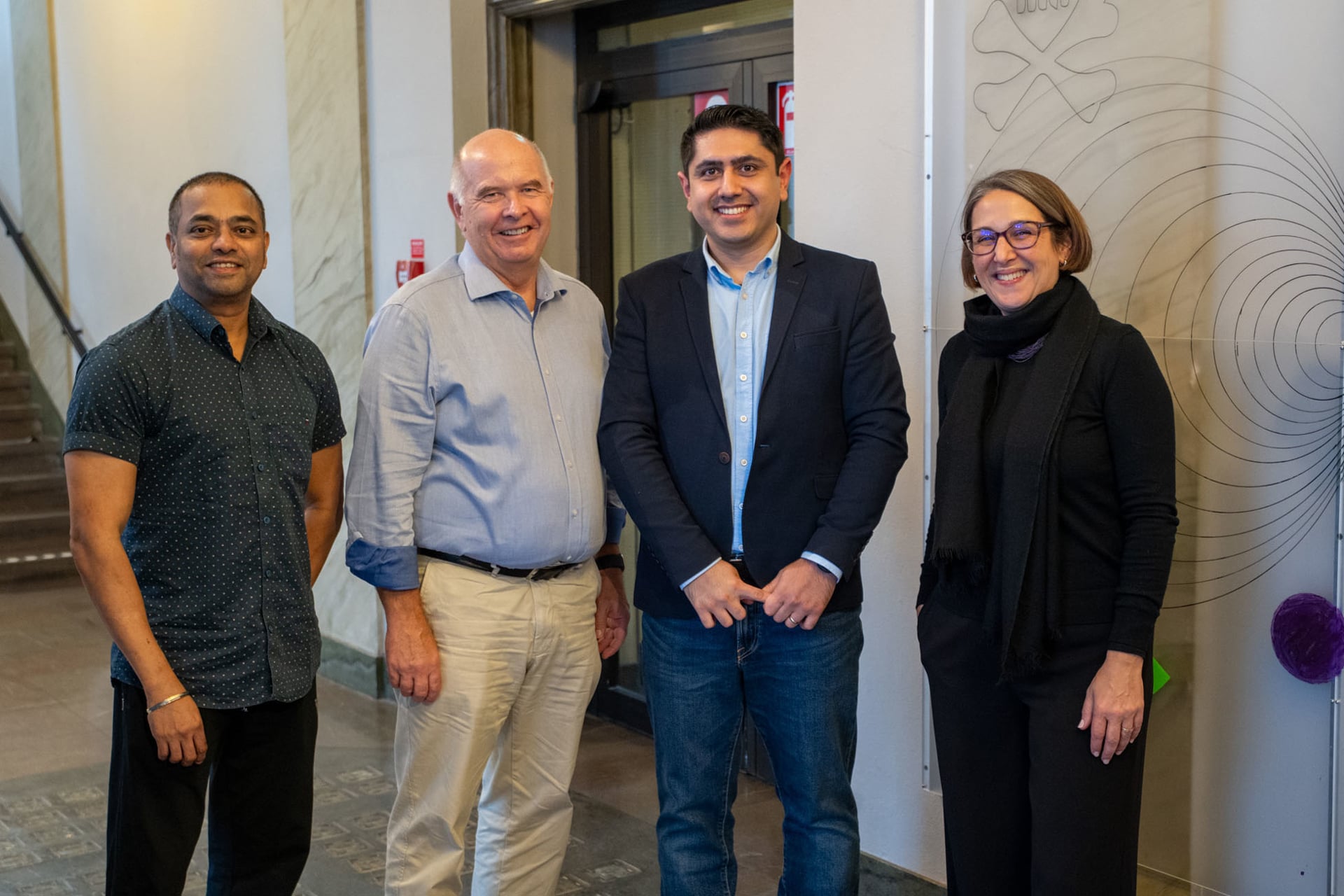
Chair of the defense: Professor Pär Åhlström, Stockholm School of Economics, Sweden.
Faculty opponent: Professor Antony Paulraj, NEOMA Business School, France.
Assessment committee:
- Professor Canan Kocabasoglu Hillmer, Bayes Business School, England.
- Associate Professor Anders Anderson, Stockholm School of Economics, Sweden.
- Professor Constantin Blome, Stockholm School of Economics, Sweden.
Supervisor
- Professor Pär Åhlström, with Iman Parsa, Anand Nair, and Matin Mohaghegh as co-supervisors.
Sina Behzadifard is a researcher at the House of Innovation and an affiliate researcher at the House of Sustainable Society at the Stockholm School of Economics. He holds a bachelor’s degree in electrical engineering and an MBA in operations and supply chain management. His research focuses on environmental operations management, particularly how firms integrate environmental practices into operations and the performance consequences of doing so.
Read the thesis: "Same Same, but Different: Hidden Dimensions of Environmental Operations Management and Their Implications for Firm Performance."

Celebratory mingle
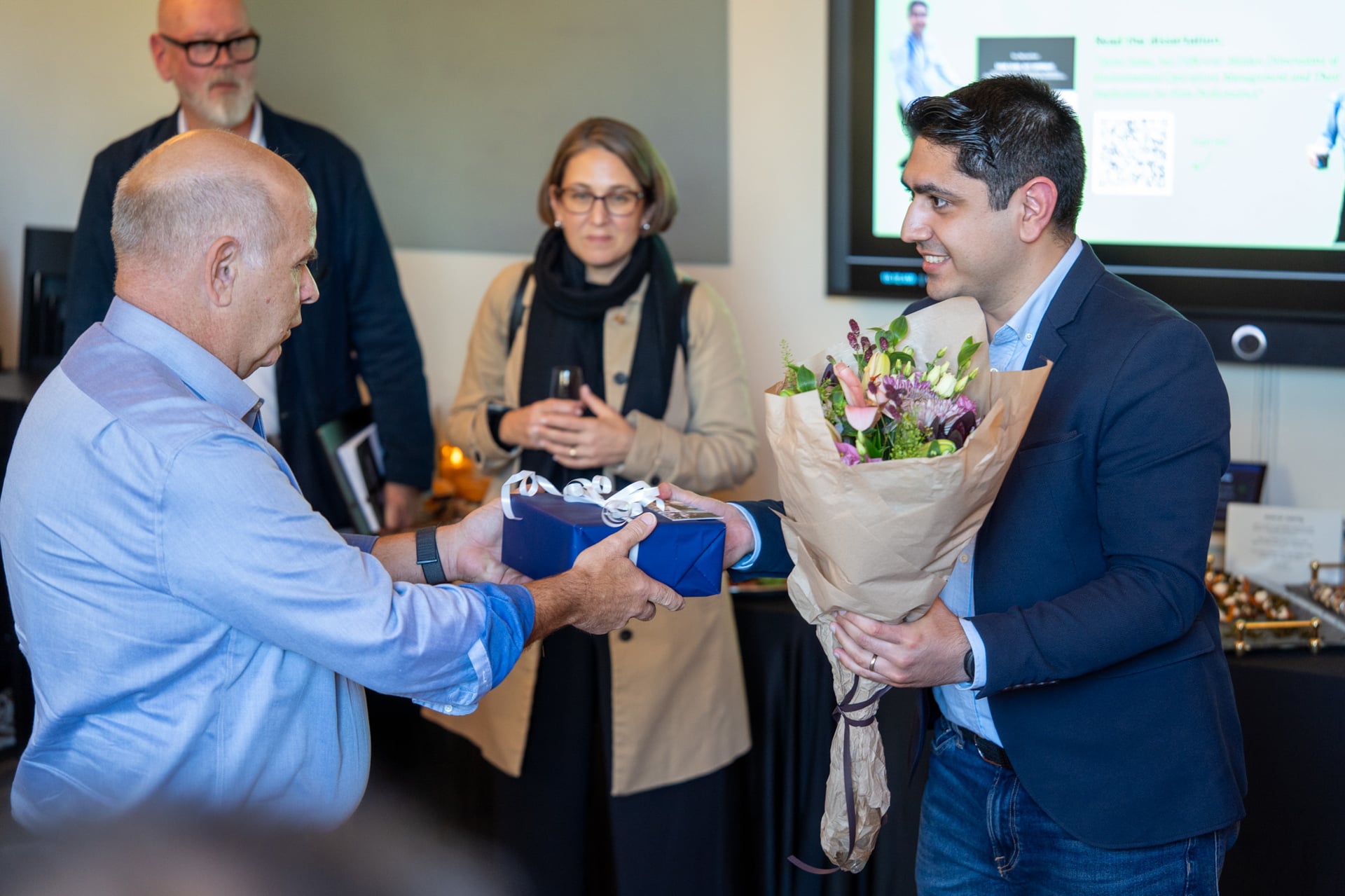
After the defense, the assessment committee excused themselves to deliberate. They returned shortly afterward to announce that Sina had successfully defended his dissertation.
A celebration then took place in the Faculty Lounge at the House of Innovation, where guests and colleagues toasted Sina's achievement.
We congratulate Sina on this achievement and look forward to following his research on sustainability and operations.