
Stockholm School of Economics appoints acclaimed composer Jacob Mühlrad as Composer-in-Residence – a global first
In a move that redraws the boundaries of business education, the Stockholm School of Economics (SSE) has appointed Jacob Mühlrad, one of the world’s most acclaimed contemporary composers, as Composer-in-Residence – the first known such appointment at any business school globally.

The initiative is part of SSE’s long-term strategy to integrate the arts into leadership education. At the heart of this vision is a growing conviction that, in a world where artificial intelligence and automation are rapidly commodifying cognitive knowledge, the deep human faculties of aesthetic judgment, interpretation, and emotional resonance are becoming central to leadership.
“When knowledge is a commodity, imagination becomes a scarce resource,” said Lars Strannegård, President of SSE. “Jacob Mühlrad brings a rare ability to move between avant-garde innovation and broad cultural resonance. His work invites us not just to feel, but to question assumptions – precisely the kind of reflection leaders need amid complexity and constant change.”
Over the course of the four-year residency, an SSE research team will study Mühlrad’s creative work as he composes several original works, some of which will be premiered in public concerts. The project will also feature his ongoing work as a composer for national and international institutions, including a commission for the London Philharmonic Orchestra and clarinetist Martin Fröst, which will receive its world premiere in London as early as January 2027.
“I am delighted to see contemporary music represented at an institution like the Stockholm School of Economics and I am impressed by the school's ability to value culture,” said Jacob Mühlrad.
The residency is funded by the Center for Security and Resilience. An important part of the project will be to explore how music and art can strengthen a society’s resilience.
“Resilience is built in people as much as in systems. A society under pressure needs to hold several perspectives at once and keep imagining what comes next. Few things train that capacity like art, and a composer at the school lets us study how it is formed,” said Martin Carlsson-Wall, Professor and Director of the Center for Security and Resilience.
During the residency, a team of scholars at SSE’s House of Innovation and the Center for Security and Resilience will conduct an ethnographic study of Mühlrad’s creative process.
“We are particularly intrigued by Jacob’s conceptual approach to creation and his capability to span across genres and disciplines,” said Roberto Verganti, the Josefsson Family Chair in Art and Innovation at SSE. “His residency will enable our students to be in close contact with his way of sensing, imagining and move people’s hearts, which are core skills for any leaders in the age of AI.”
This appointment builds on the recognition SSE has received for its pioneering work over the past decade to integrate the arts into its strategy. SSE’s approach places it at the forefront of a movement to humanize business education. Not by softening it, but by sharpening its relevance.
“Few things move us as deeply and as instantly as music. It resonates in the mind, the body, and the soul,” said Strannegård. “Jacob’s presence at SSE reflects our conviction that education must do the same. We want to cultivate leaders with not only sharp intellects, but also emotional depth and sensory awareness – qualities essential for navigating the unknown.”
In placing a composer at the heart of its institution, SSE is composing something itself: a new score for what leadership education might sound like in the 21st century. It reflects a deeper wager: that the future of leadership will depend not just on what we know, but on how we interpret, imagine, and create meaning.
About Jacob Mühlrad
Jacob Mühlrad, born in Stockholm in 1991, composes choral music, orchestral works, and solo concertos, often drawing on Jewish liturgy. He has collaborated with leading musicians such as Alan Gilbert, Martin Fröst, Pablo Heras-Casado, and Matthias Pintscher, as well as with institutions including the Tokyo Symphony Orchestra and the Swedish Radio Symphony Orchestra. His works have been performed at Carnegie Hall and Suntory Hall in Tokyo, as well as by Radio France.
His debut album, TIME (Deutsche Grammophon), received five stars from BBC Music Magazine, and The Economist has described him as “an unusually versatile composer.” He has also worked with artists in electronic and popular music, including 070 Shake and Swedish House Mafia. In 2025, he composed the music for the Nobel Banquet at Stockholm City Hall.
Last August, Mühlrad’s HELIX premiered at the BBC Proms at the Royal Albert Hall, with Martin Fröst as soloist. On November 29, he will curate the Royal Swedish Opera’s farewell concert together with Alan Gilbert, featuring his own works alongside historical pieces. In January 2027, the London Philharmonic Orchestra and Martin Fröst will give the world premiere of KAVANAH at Queen Elizabeth Hall, London. In March 2027, Mühlrad will curate and compose the music for the inauguration of Gasometer in Stockholm.
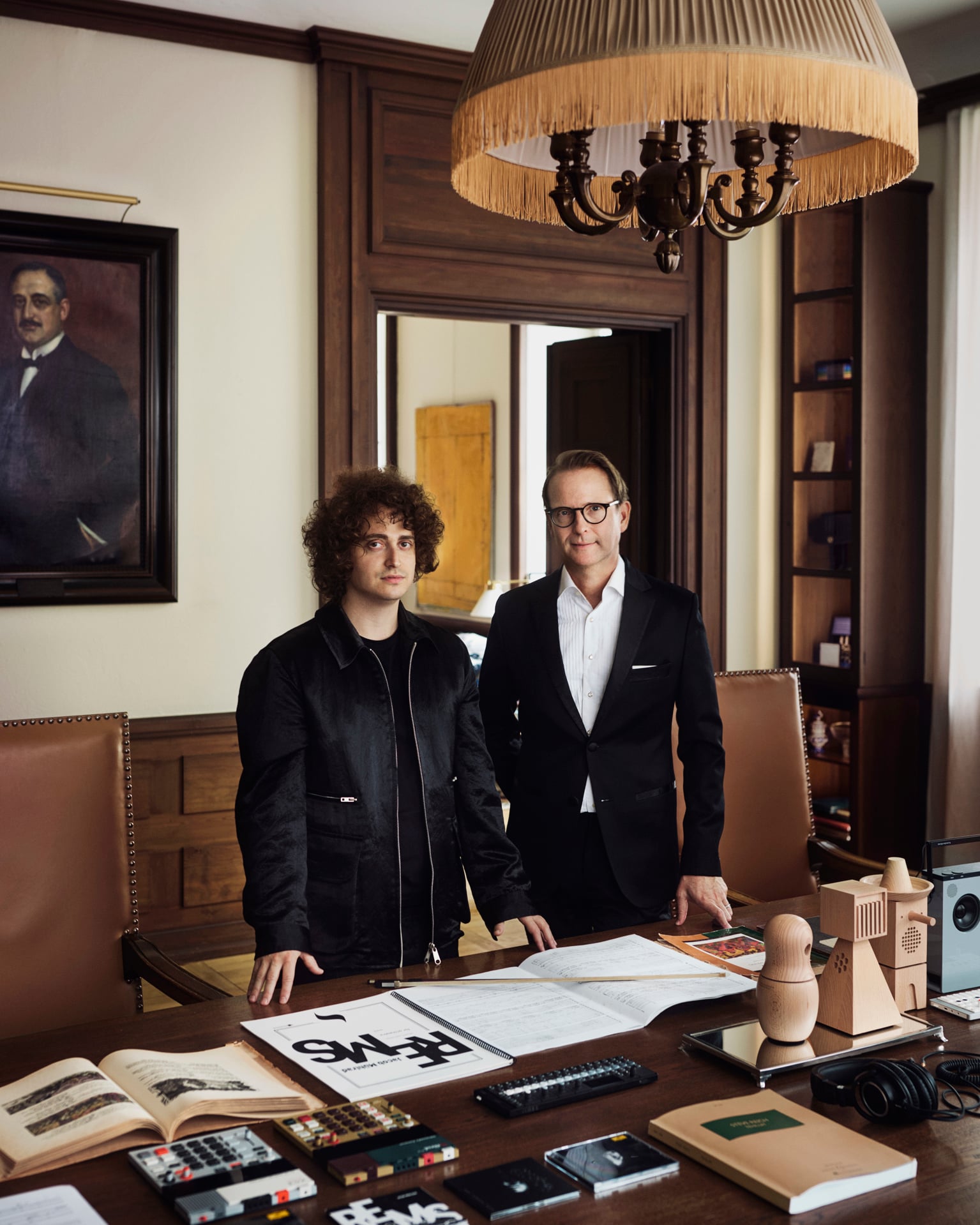
Jacob Mühlrad, Lars Strannegård
Photo: Pierre Björk
High resolution jpg image 5.5mb
For more information:
Ann-Louice Dahlgren
Global Outreach Manager
Stockholm School of Economics
+46 708 433 119
ann-louice.dahlgren@hhs.se


