
Swedish Football at a Crossroads: Seminar Highlights Path Forward

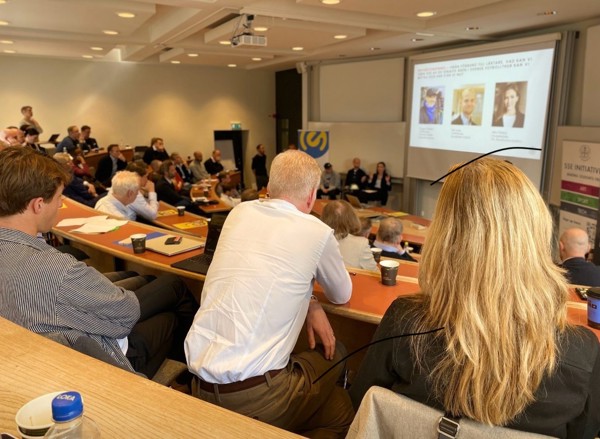
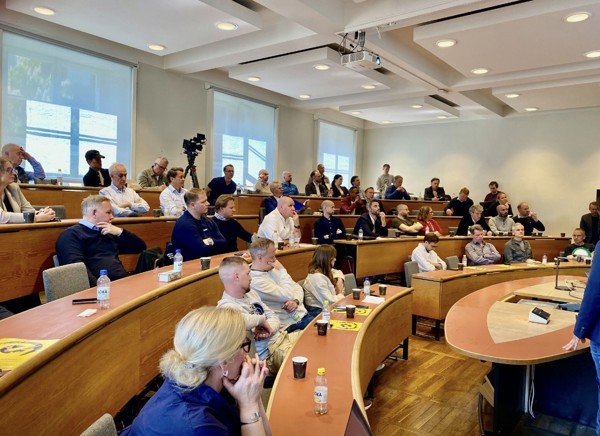
Throughout the morning, key topics were explored, including club democracy, supporter culture, sustainability, security, and financing - all vital to the long-term development of the sport in Sweden.
The event featured a wide range of speakers and panelists who generously shared their insights and perspectives, creating a dynamic conversation at the intersection of sports, society, and business.
Speakers & Panelists included:
- Joakim Lundquist - ENABLE Sweden / CEO Lundquist
- Filip Lundberg Verendel - Djurgården Football / ENABLE Sweden
- Anders Almgren - ENABLE Sweden
- Martin Carlsson-Wall - Professor, Stockholm School of Economics / Center for Sports & Business
- Noa Bachner - Journalist & author
- Tryggve Pederby - SFSU (Sweidsh Football Supporters Union)
- Jenny Silfverstrand - CEO, SHL (Swedish Hockey League)
- Nike Örbrink - Politician (Christian Democrats) & AIK supporter
- Erik Gozzi - Chairman, Djurgården Football
- Jens T Andersson - Chairman, Swedish Elite Football (SEF)
Martin Carlsson-Wall, Professor and Research Director of the Center for Sports & Business, kicked off the event by giving a backdrop to what is currently happening within the Swedish football ecosystem, including three new appointments of General Secretaries, as well as the performance(s) of the female and male football national teams.
Filip Lundberg Verendel and Joakim Lundquist centered their keynote on sustainability in football. Lundberg Verendel explored sustainable development within the context of Swedish football, presenting ENABLE's perspective on sustainability. His focus included topics such as the license to operate, the balance between conservatism and innovation, the importance of local communities, fan culture, membership-based democracy, and the need for collaboration between practitioners and academics.
Joakim emphasized the need for greater professionalization within Swedish football. He noted that many clubs currently approach sustainability in a limited way — treating it as separate from the sporting side, often through isolated projects or initiatives disconnected from the club’s overall strategy.
He cautioned against engaging in sustainability reporting merely for its own sake. Instead, he advocated for a strategic approach where sustainability is integrated into the core operations in a structured manner, with projects and initiatives designed to support and strengthen those operations. Additionally, he identified four key areas that all football clubs must address: the 51% rule and membership democracy, ensuring safe and well-managed events, generating increased financial resources through partnerships, and strengthening the engagement with politicians.
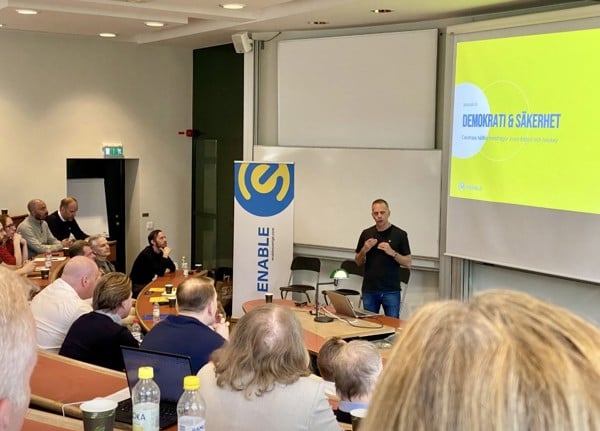
Next, Anders Almgren spoke about democracy and safety as two of the most fundamental aspects of sustainability in football. He explained why both should be viewed as sustainability issues, how a sustainability analysis can provide valuable support, and how sustainability can serve as a guiding principle. Almgren emphasized the importance of addressing both short- and long-term perspectives - ensuring the immediate issue is handled effectively while also strengthening the broader club system. He argued that sustainability efforts should be rooted in the core operations and be a win-win. Democracy, he noted, is the foundational value of sport, providing stability and fostering supporter engagement. Safety, meanwhile, is essential for successful event management and for ensuring that both supporters and the general public feel secure during football matches.
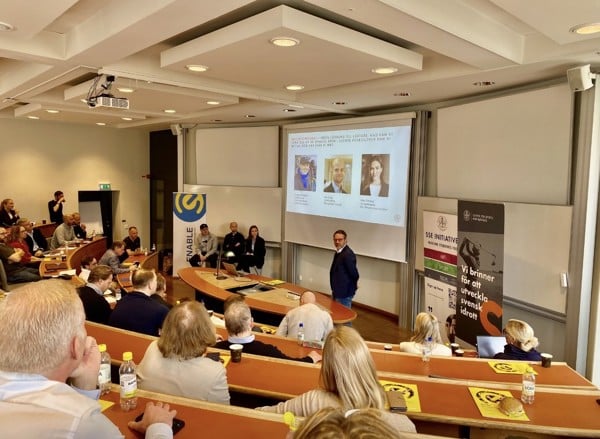
Tryggve Pederby, Erik Gozzi, and Nike Örbrink participated in a reflection panel titled From the Federations to the Stands – What Can We Learn from Recent Years in Swedish Football? How Can We Come Together, and Where Do We Stand Today?
Nike Örbrink criticized the current political discourse around football, which she felt is overly focused on disorder and disturbances - a narrative rooted in the past, rather than putting energy into how we can create better conditions for sport in Sweden. She highlighted the urgent need for investment, noting that Stockholm alone would need 40 new football pitches. According to Nike, football should better showcase the many positive contributions it makes, such as clubs taking on significant social responsibility in suburban areas.
Erik Gozzi, newly appointed chairman of Djurgården IF, emphasized the importance of membership democracy. He stated that long-term decisions within a club should be made by people who carry the spirit of the club with them. He also stressed the need to protect club staff from excessive external pressure, enabling them to work long-term, as the current intensity is unsustainable.
Tryggve Pederby expressed frustration over how the public debate is dominated by discussions of disorder. He and others are involved because of their passion for football and the culture surrounding it. They take pride in the democratic process and want to focus on those values. He stressed that a strong democratic force will be essential in defending the sport’s core values as football continues to evolve.
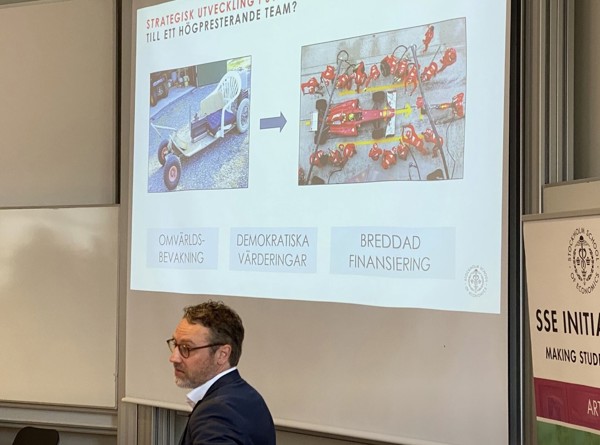
Martin Carlsson-Wall delivered a keynote on the topic of financing, exploring global trends and their implications for Sweden. Drawing on insights from visits to the United States and its sports ecosystem, he highlighted the importance of learning from international models. Carlsson-Wall emphasized the concept of ambidexterity: the ability to balance tradition with innovation. He argued that the future lies in building teams that embody both — preserving core values while embracing change. Three key focus areas emerged from his talk: Tracking global developments, by visiting other countries and welcoming them to Sweden to foster mutual learning and relationship-building; safeguarding democratic values, ensuring these remain at the heart of football governance; and broadening financing models.
The final panel featured Jens T. Andersson, Jenny Silfverstrand, and Noa Bachner, and centered on the topic: A Shared Vision for Swedish Football – Is It Desirable, What Should It Include, and How Do We Create It?
To inspire the discussion, Jenny Silfverstrand shared the Swedish Hockey League’s vision of delivering the world’s best hockey experience as an example of a unifying goal. Jens T. Andersson emphasized that we should take pride in the Swedish football ecosystem. Despite limited financial resources, Swedish football performs at a high level, and international observers are often impressed, not least by the vibrant atmosphere in the stands.
Noa Bachner proposed the establishment of a dedicated committee tasked with developing a long-term vision for Swedish football, imagining what it should look like and represent 20 to 30 years from now.
The key strength of this movement — football — is that it creates deep meaning in people's lives. That’s also the perspective we should bring when approaching business and politics.
Noa Bachner
Watch Recording
What is at Stake?
Public Order Situation & Trends: This report takes its starting point in the recent years' negative developments in public order. However, we look back to the relatively positive situation in the late 2010s; a major pyrotechnic scene, but few other disturbances. What can we learn from this development?
Current Work and Supporter Culture: We describe the Swedish approach, which has long been comparatively balanced - on the one hand, using controlling, law-enforcing methods, and on the other, normative, dialogue-based approaches - something supported by both research and experience. We also note that Swedish supporter culture is often somewhat less radical than its counterparts across Europe. Could there be a connection?
"Continental methods risk creating continental problems - that does not benefit public order."
Current Situation - A Crossroads: We further note that the current public order situation, combined with a highly emotionally driven debate, presents a crossroads for football security efforts. Judging by the tone of the debate, major changes may be on the way - perhaps even a paradigm shift?
The Choice for the Future: Research and experience emphasize the importance of balancing repression with normative approaches. There is a risk if the debate is dominated by an investigative directive that has already stated repressive legislation as the primary action - and explicitly cited countries like the UK and the Netherlands as sources of inspiration. If we work like they do in Europe, it is not unthinkable that the results will mirror Europe. That would not benefit public order.
The Report - A Swedish Model for Working with Football Security?
Part I: Future Security Work - A Crucial Choice
Part I discusses the goals of security work, current public order trends, and perspectives on the Swedish approach. It reflects on the importance of upcoming decisions and how these may shape the future of football security in Sweden. Are we on the right path? Do we understand what we are about to choose?
Part II: Fundamentals and Context
Part II describes the foundations for a positive football environment, including the roles of football organizations, the police, and supporter culture. The three chapters first examine the work from an experience-based perspective, then from a research perspective. Finally, it analyzes the factors and contexts that together support a sustainable and knowledge-based approach.
Part III: Reflections and Recommendations
Part III summarizes the public order situation and discusses a primary short-term objective: to combat the disturbances that have accelerated after the COVID pandemic. We describe the challenges and strengths we observe in the Swedish approach. Based on this, a number of recommendations are made for how football security efforts can evolve - both strategically and operationally.
From the report A Swedish Model for Working with Football Security?
Starting Points - Priorities, Strengths, and Areas for Improvement


