
The Linder Lounge: Andreas Eriksson and Jonas Bohlin
The Linder Lounge is an arc-shaped corridor in the Stockholm School of Economics’ main building from 1925. At its centre is Hundrundan (The Dog-Walking Loop), a new site-specific, 14-metre-long frieze by Swedish artist Andreas Eriksson. Together with study furniture by Jonas Bohlin, it creates a welcoming place for concentration, conversation and encounters with art.

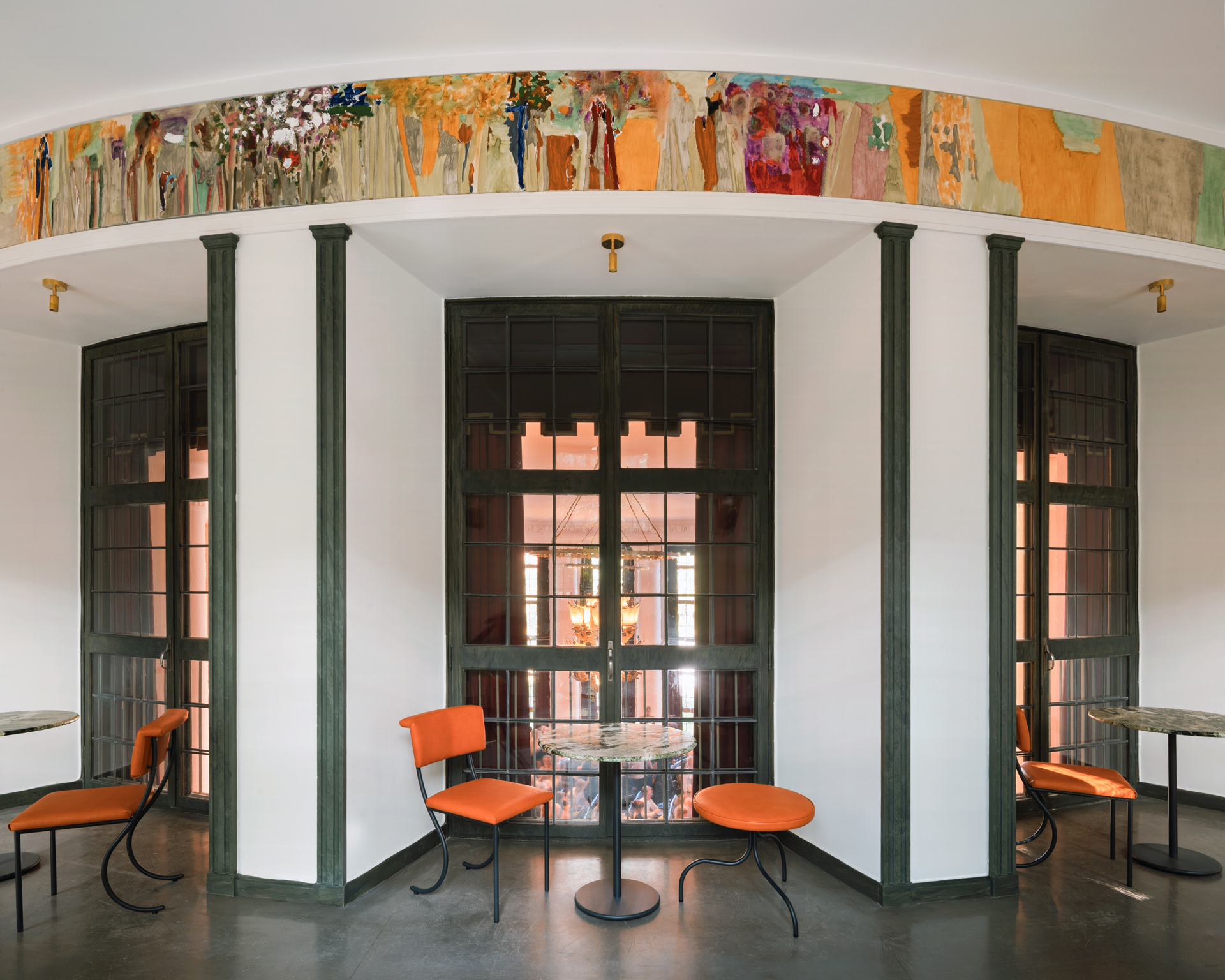
Hundrundan (The Dog-Walking Loop) by Andreas Eriksson, 2026, and furnitures by Jonas Bohlin.
All photos by Mikael Olsson.
Ivar Tengbom’s beautiful 1925 building at Sveavägen 65 – the Stockholm School of Economics’ main building – has a rotunda at one end. The rotunda houses the library and the circular auditorium, encircled by a series of arc-shaped corridors. One of these corridors has now been transformed into The Linder Lounge – a gift to our students and a place to study, pause and meet. From the corridor, students can also look into the auditorium and follow lectures taking place just below them.
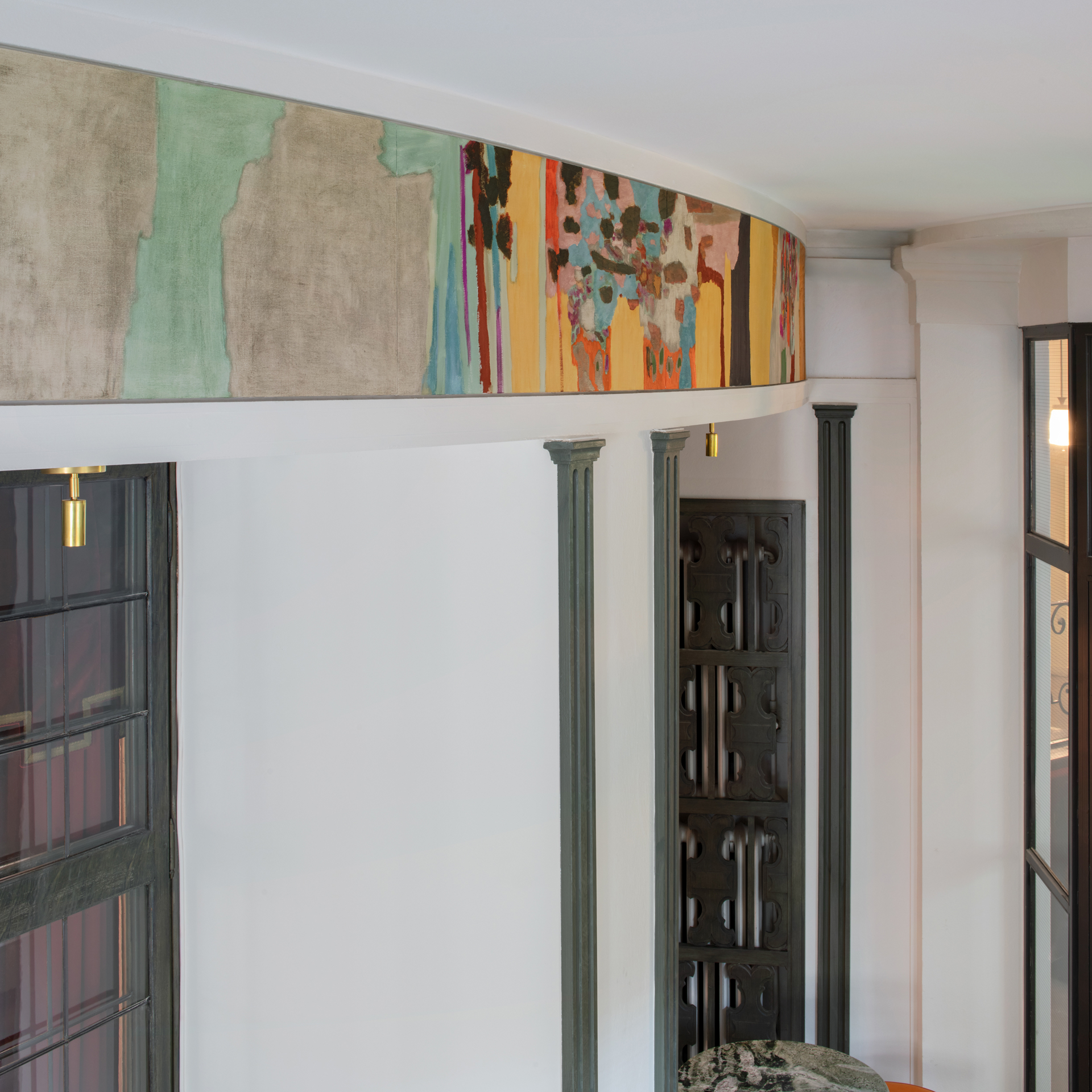
The defining feature of the lounge is Andreas Eriksson’s Hundrundan. The frieze follows the curve of the corridor, allowing the work to unfold gradually as the viewer moves alongside it. Its title refers to Eriksson’s daily walks with his dog through the landscape surrounding his home on Mount Kinnekulle – the primary source of inspiration for his art. Through shifts in colour, texture and rhythm, impressions of this landscape are brought into the School.
With Hundrundan, Eriksson continues a long tradition in art and architecture while approaching the frieze in a distinctly contemporary way. Two of art history’s best-known examples are the Parthenon Frieze, which depicts the Panathenaic procession in ancient Athens, and Gustav Klimt’s Beethoven Frieze, an allegorical work inspired by Beethoven’s Ninth Symphony and humanity’s search for happiness. Both unfold as narrative sequences along a wall.
Eriksson, who has explored the frieze format in earlier works, takes up this history but shifts the emphasis away from storytelling. Hundrundan does not depict a sequence of events. Instead, it is built from impressions – fragments of landscape, changing light, organic forms and painterly textures. The work offers no prescribed path or narrative, inviting each viewer to explore it through their own movement and attention.
The lounge is furnished with Jonas Bohlin’s now-classic designs—including sofas, chairs, stools and tables. The chairs, sofas and stools were designed for the restaurant Riche in 2001 and can still be found there. The table was designed especially for SSE, with decorative letters projecting from its legs that spell out FREE, expressing the School’s educational mission and its commitment to educating students who are Fact-based, Reflective, Empathetic and Entrepreneurial.
Together, Eriksson’s frieze, Bohlin’s furniture and Tengbom’s architecture have given the School a new and welcoming atmosphere. A once transitional corridor has become a destination in its own right – a place to inhabit, experience and return to.
The Linder Lounge was made possible through a generous donation from Malin and Stefan Linder through the ISOJA Foundation.
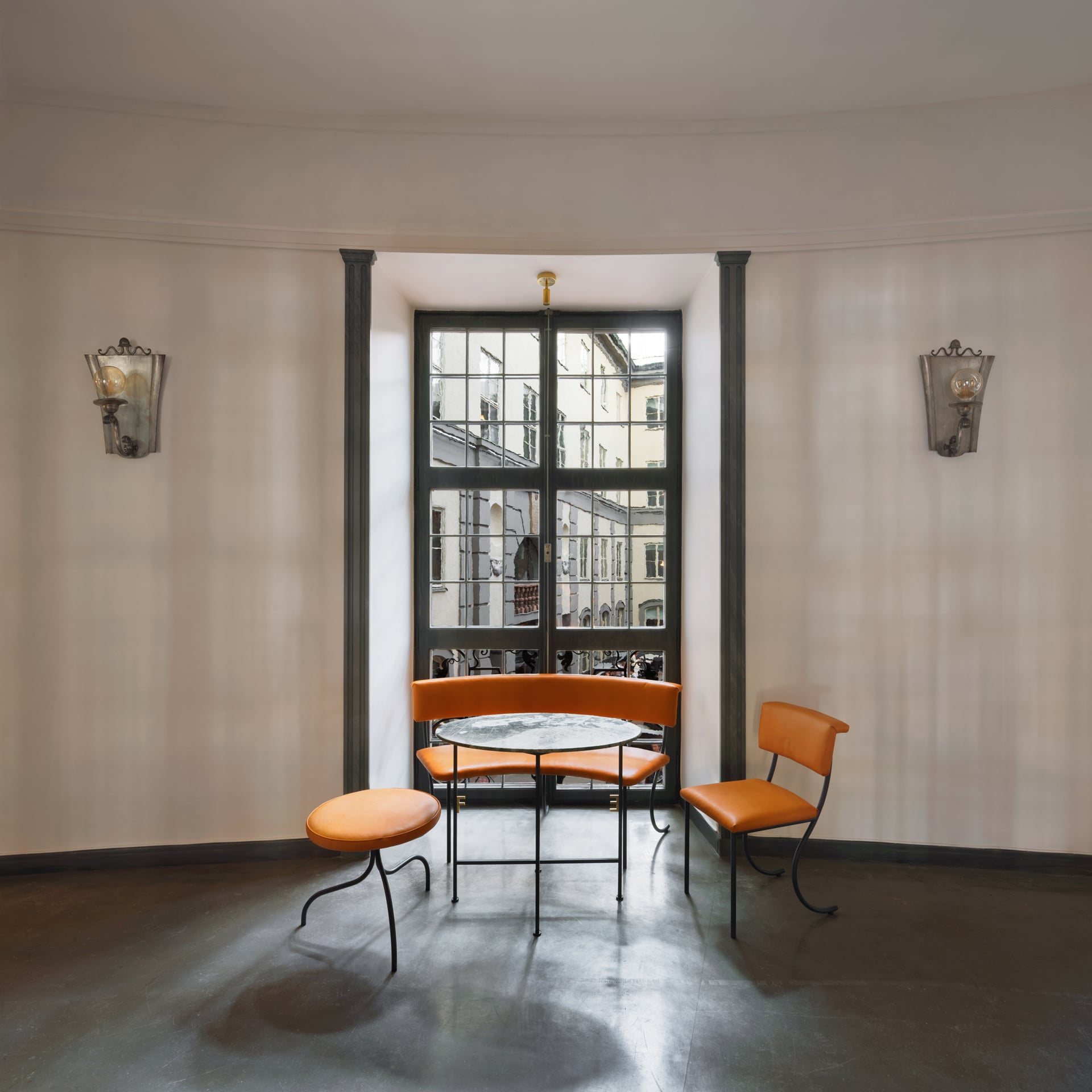
Jonas Bohlin’s now-classic designs – the sofas and chairs from the Tivoli series, originally designed for Restaurant Riche in Stockholm; the Karusell stools; and tables designed especially for SSE, with our educational mission, FREE, projecting from their legs.
Andreas Eriksson (born March 17, 1975, in Björsäter, Sweden) is one of Sweden’s most internationally prominent contemporary artists. He is best known for his tactile, evocative works, which occupy the area between pure abstraction and figurative landscape painting. He lives and works in Medelplana on Mount Kinnekulle, near Lake Vänern. The natural landscape surrounding his home on Kinnekulle, which he explores on daily walks with his dog, is his primary source of inspiration.
His paintings often function as structural, organic “topographies.” Elements such as shifting light over fields, tree bark, soil, and moss are transformed into blocks of colour and dense painterly textures.
While painting remains central to his practice, Eriksson works across a wide range of media. He moves fluidly between painting, photography, sculpture—often in bronze or porcelain—film, printmaking, and large-scale textile art.
In recent years, he has gained significant recognition for his monumental tapestries. Working closely with master weavers, he translates his fluid watercolour sketches into tactile textile works made from undyed linen, in which the varying density of the yarn itself creates the landscapes.
Eriksson studied at the Royal Institute of Art in Stockholm from 1993 to 1998. Recognized early on as a major talent, he established a base in Berlin after graduating. He is represented by neugerriemschneider.
In 2011 Eriksson was selected to represent Sweden at the Venice Biennale. His works are held in major public collections worldwide, including Moderna museet in Stockholm, the Centre Pompidou in Paris, and the Louisiana Museum of Modern Art in Denmark.
Jonas Bohlin (born in Stockholm in 1953) is regarded as one of Sweden’s most influential contemporary designers. He is a Swedish furniture designer and interior architect, and achieved his breakthrough with Concrete, a chair made of steel and concrete for his 1981 graduation project at Konstfack. The work blurred the boundary between furniture and art.
Bohlin’s designs are often conceptual and expressive, combining construction with emotion and craftsmanship. Alongside furniture and lighting, he has created interiors for prominent Swedish restaurants such as Riche and Sturehof. He has also taught at Beckmans College of Design and served as Professor of Furniture Design at Konstfack.
Jonas Bohlin works closely with Ingridsdotter, a Swedish design brand founded by Christine Ingridsdotter in Stockholm in 2021. The company produces and represents the largest collection of Bohlin’s furniture and lighting, and focuses on preserving Bohlin’s design legacy through small-scale Swedish production, durable craftsmanship and traceable materials.
What is a frieze?
In art history and architecture, a frieze is a long horizontal band of sculpture, painting, or decoration that runs along a wall, ceiling, or structural beam. It serves both an aesthetic purpose — articulating architectural transitions — and often a narrative or iconographic one.

