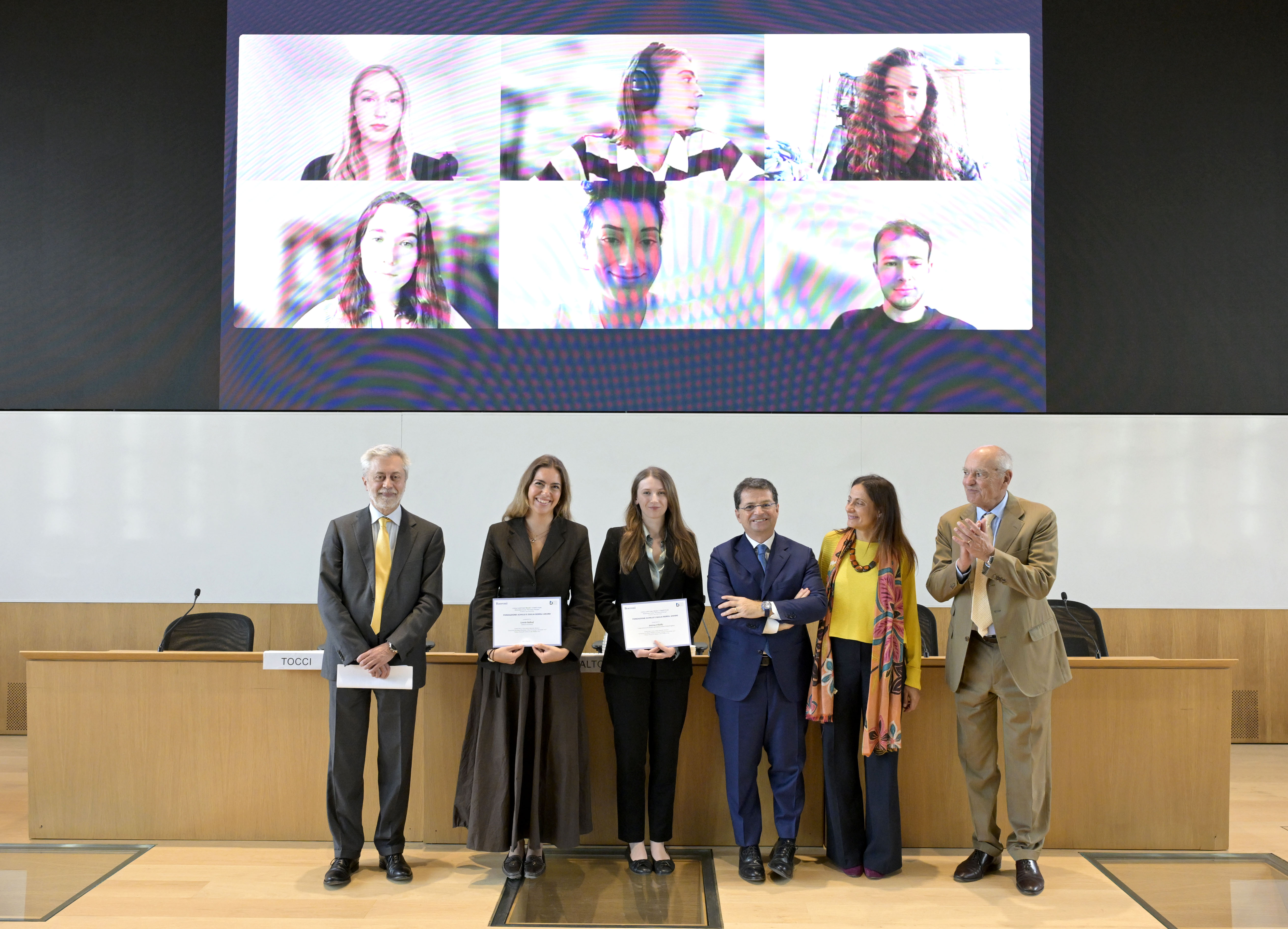
SSE students awarded prestigious Boroli Prize for CIVICA projects

Students from the Stockholm School of Economics (SSE) have been awarded the prestigious Boroli Prize following their participation in a CIVICA multicampus course. The prize recognizes outstanding student work on European policy challenges and highlights the role of international collaboration in addressing complex societal issues.
Following the wins, Diana Gonzalez Anaya interviewed two of the awarded students, Elna Jannatti and Cassandra Åstenius. Read their thoughts below.
What motivated you to apply for the CIVICA multicampus course, and what were you hoping to gain from it?
Elna: "The course’s focus on European politics stood out for me! I was eager to deepen my understanding of political dynamics in Europe and to engage with the subject in an international learning environment. Overall, I saw the course as a valuable opportunity to both expand my knowledge and develop my ability to collaborate across borders."
Cassandra: "I decided to apply because it felt like a great opportunity to step outside the usual finance curriculum and think more broadly about the kinds of issues that will shape Europe in the coming years. I was also drawn to the CIVICA format itself as working with students from other European universities on a real policy project seemed really relevant."
Can you walk us through your team’s capstone project and why it matters for Europe today?
Elna: "Our team’s capstone project examined how social media contributes to increased polarization among young users. While public discussions often focus on how platforms shape body image or lifestyle expectations, far less attention is given to how emotions such as anger, fear, or enthusiasm drive political polarization and influence how young people engage with politics."
Cassandra: "Our capstone project focused on a big tension in Europe right now: how the EU can regulate AI in a way that protects citizens’ rights and safety, while still making Europe competitive in a very fast-moving global landscape."
What was it like working in a transnational team, and what challenges did you face?
Elna: "Working in a transnational team was a very rewarding experience. It challenged me to think beyond my usual frame of reference and to approach problems in a more open and reflective way. Interestingly, the main challenges we faced were not necessarily related to being a transnational group. Instead, they were similar to those encountered in any collaborative setting, such as coordinating different ideas, aligning expectations, and reaching consensus. However, navigating these differences ultimately strengthened our teamwork and improved the quality of our final output."
Cassandra: "This was definitely an exciting part of the course. Everyone came in with different academic backgrounds and perspectives, which made the project much stronger and helped us approach the same issue from different angles. Of course, we also had to navigate different schedules, working styles and priorities, so communication was really important in making the process work."
How did this experience differ from your studies at SSE, and what key skills did you develop?
Elna: "As a Master’s student in Finance, my coursework is typically quantitative and focused on markets, investments, and financial theory. In contrast, this course centered on European politics, which pushed me to engage with entirely new concepts and ways of thinking. One of the key skills I developed was a broader understanding of the European Union and political processes, which I believe is valuable regardless of one’s field. Beyond that, I strengthened my ability to think critically about complex societal issues, to approach problems from multiple perspectives, and to communicate ideas in a more analytical and structured way."
Cassandra: "What made this course different from my studies at SSE was how open-ended the challenge was. In finance courses, the problem is often clearly defined and there is a fairly clear analytical path. Here, a big part of the work was identifying the right problem and then turning that into a realistic policy proposal. I found this really valuable since it pushed me to think more across disciplines and to place business and innovation questions in a broader policy context. "
What does winning the Boroli Prize mean to you, and how do you hope your project will have real-world impact?
Elna: "Winning the Boroli Prize is very meaningful to me, especially because it represents growth in an area I had not previously explored in depth. Coming from a finance background, engaging with questions of politics, media, and society pushed me outside my comfort zone, and being recognized for that work is both rewarding and motivating. I hope that our project can contribute to ongoing discussions among policymakers and stakeholders, particularly around the regulation of algorithms on social media platforms."
Cassandra: "Winning the Boroli Prize is really exciting as it feels like recognition of both our project and the relevance of the issue we worked on. What makes it especially meaningful is that this was a true team effort where the final result came from many rounds of discussion, feedback and refinement. In terms of impact, I hope our project can contribute to the broader discussion on how Europe approaches AI governance – especially the idea that Europe should not have to choose between protecting citizens and staying innovative."
How has this experience shaped your future plans, and what advice would you give to future SSE students?
Elna: "My advice to future SSE students would be to step outside their comfort zones. Take courses that challenge you and go beyond the typical scope of your program. I would also strongly encourage working with people from different backgrounds. Collaborating with individuals who think differently and bring diverse perspectives can significantly deepen your learning and make the experience far more rewarding than staying within your usual circle."
Cassandra: "This experience made me more interested in questions that sit at the intersection of finance, policy and technology. It also made me realise how important it is to understand not just markets or companies in isolation, but also the institutional and policy environments that shape them. My advice to future SSE students would definitely be to apply if they want to work in an international and interdisciplinary setting and try something that is a bit different from other course formats at SSE. Furthermore, it is genuinely fun to work on a project that is so relevant and connected to real-world issues."
Learn more about CIVICA at the Stockholm School of Economics here.