From eco-anxiety to eco-agency: turning pressure into action

The event brought together voices from policy, research, business, and psychology to discuss how societies can respond to environmental challenges without becoming overwhelmed.
Global uncertainty requires long-term thinking
In his opening address, Adrian Junker, Ambassador of Switzerland to Sweden, reflected on how rapid technological development, particularly artificial intelligence, together with geopolitical tensions is reshaping markets, economies, and decision-making.
At the same time, he highlighted that countries such as Sweden and Switzerland are well positioned to face these changes. Strong education systems, stable institutions, and sustained investments in innovation and infrastructure create a foundation for addressing long-term global challenges.
From stress to strategy
A central theme throughout the evening was how organizations can move from reacting to pressure toward building the capacity to act. Martin Studer, Chairman and General Partner of Bluerain Partners Group, emphasized that progress depends on the ability to collaborate across sectors and transform concern into coordinated action.
Professor Mattia Bianchi, Platform Director at the House of Sustainable Society, illustrated these ideas through the example of Sweden’s forestry sector. Around 300,000 private forest owners own about half of the country’s forest land, creating a complex system of shared responsibility. In such systems, understanding how individuals see their role and capacity to influence outcomes can be just as important as introducing new policies or technologies.
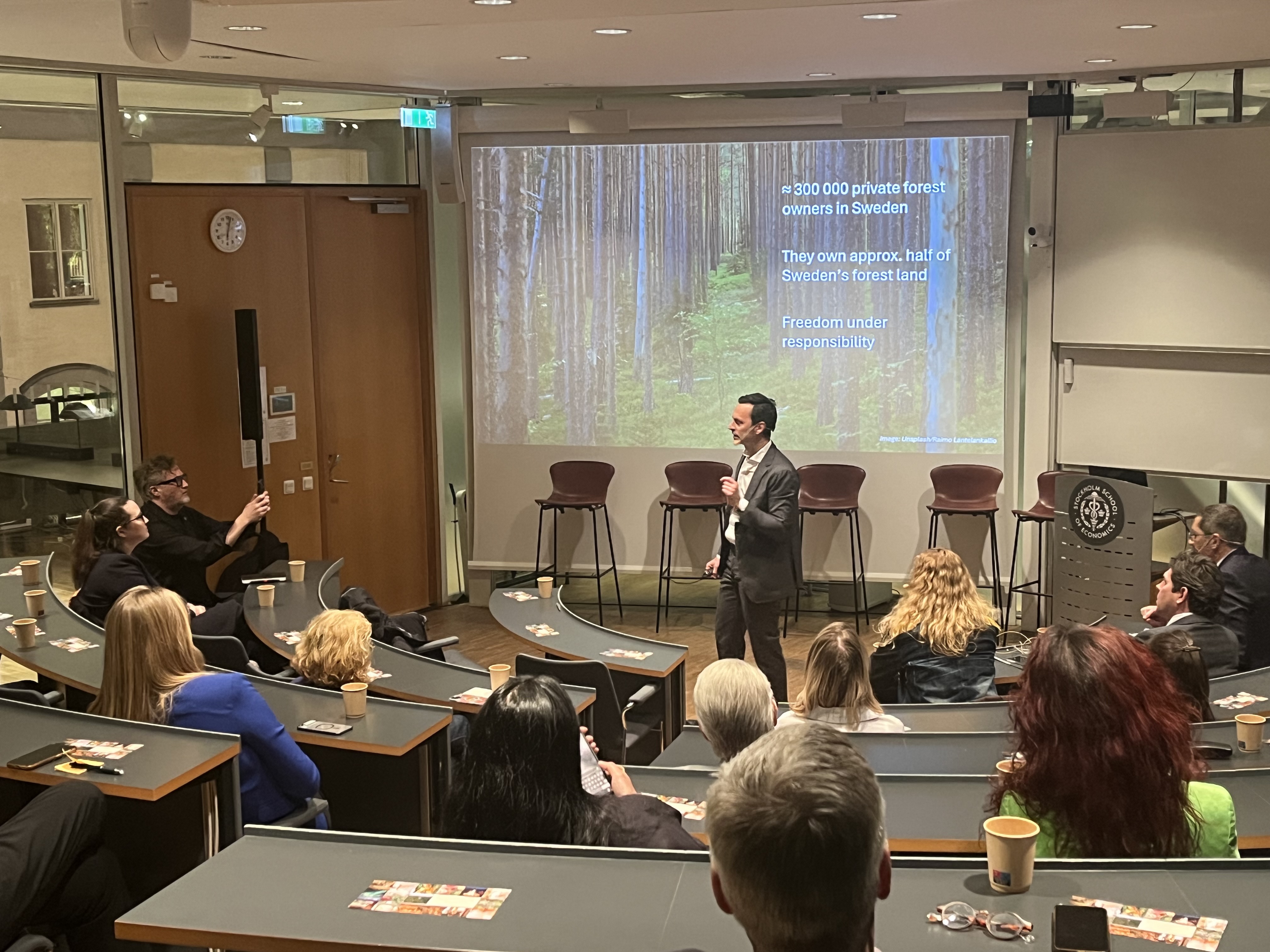
Professor Mattia Bianchi during his keynote speech. Photo: Elpida Avgeri
Innovation and new tools for sustainability
Several speakers highlighted how entrepreneurship and technological innovation can support environmental progress. Thérèse Lundquist, Founder and CEO of Green Little Hearts, presented how her company works to connect brands and consumers through products designed to be sustainable and recyclable.
New technologies are also helping researchers and conservation organizations better understand ecosystems. Andres Vergara, CMO of InvestConservation, described how artificial intelligence can analyze sound recordings from tropical forests in Ecuador to measure biodiversity. These insights help direct funding toward conservation efforts while also supporting local communities through employment and environmental protection.
Turning concern into action
The psychological dimension of climate change was addressed by Niklas Laninge, Psychologist at Opti. His contribution focused on climate anxiety and how behavioral insights can help transform concern into meaningful action when people have the right motivation, capabilities, and opportunities.
Taken together, the discussions highlighted that ecological and psychological pressure do not have to lead to fatigue. When paired with collaboration, innovation, and clear strategic direction, they can instead become a catalyst for collective action.