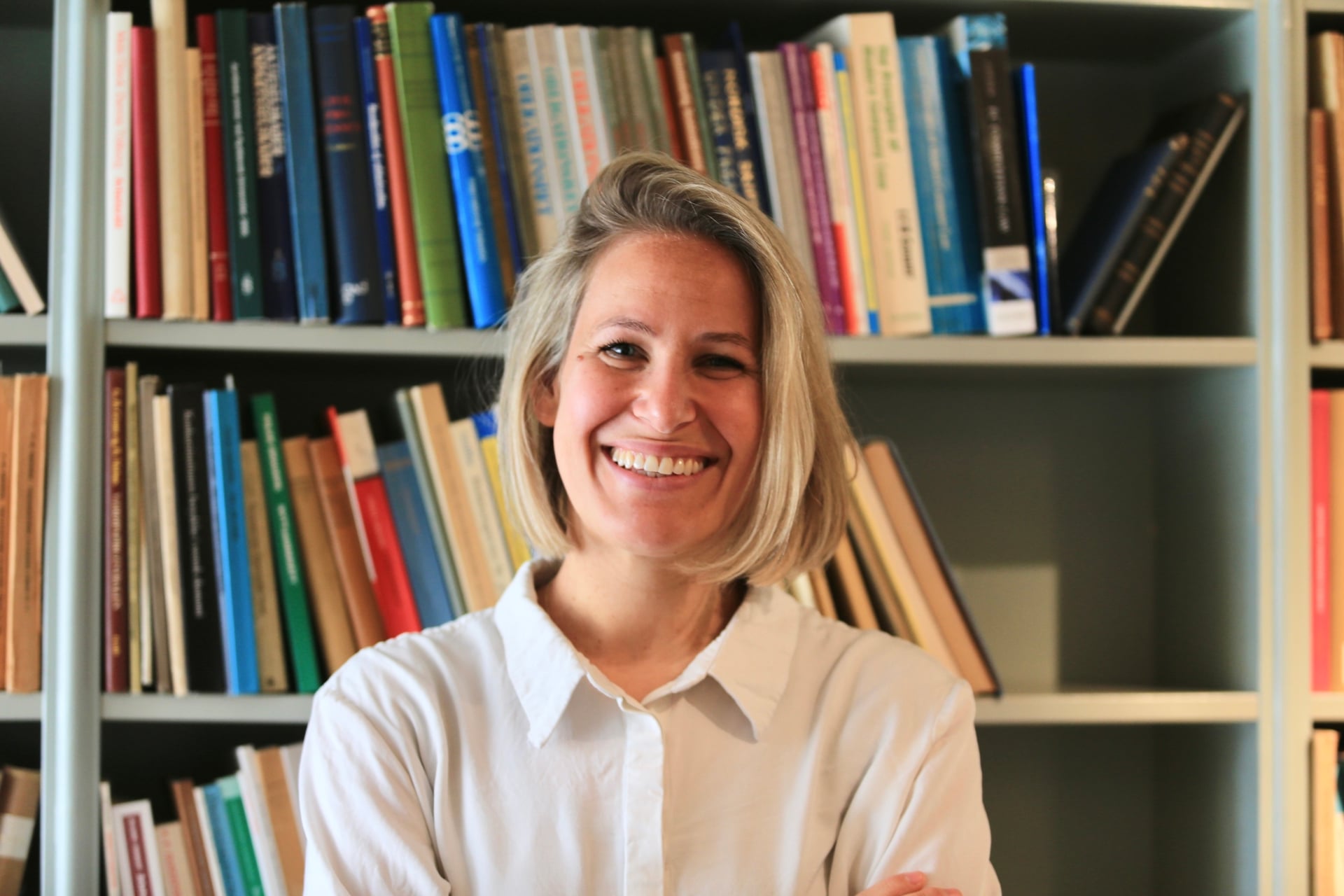
Closing the gap between commitment and practice: Spotlight on Julia Grimm
How can collaboration help us move towards a more sustainable future? That question has guided the career of Julia Grimm, affiliated with the House of Sustainable Society since 2025. Her research explores how companies, policymakers, and civil society work together to tackle complex sustainability challenges, from high-level commitments to on-the-ground implementation.

When Rana Plaza, a garment factory in Bangladesh, collapsed in 2013 it sparked global outrage. For Julia Grimm, then a student in Germany, it raised a question that would shape her future research: how can companies be held accountable for human rights violations that occur deep within their supply chains?
More than a decade later, that question still drives her work.
Originally from Germany, Julia completed her undergraduate, master, and PhD studies there, while spending time abroad throughout her education. Her academic career has taken her across Europe, including positions in Amsterdam, Cambridge, Zürich, and Jönköping. And finally, to Stockholm and her current position as Assistant Professor at Stockholm University.
"If you want to stay in academia, it’s an advantage if you’re flexible," Julia says. "I moved between countries because that's where the opportunities were. Now that I have a family, I realize how unusual that level of mobility really was."
Researching collaboration for a sustainable future
Despite working across different institutions and disciplines, her research focus has remained remarkably consistent.
"What I'm interested in is understanding why and how organizations collaborate to address major societal challenges," Julia says. "Collaboration is the phenomenon that fascinates me."
Her work explores how companies, governments, NGOs, and other actors come together to tackle issues such as human rights violations or climate change. Much of her early research examined collaborations between large companies that sought to improve conditions in global supply chains following the Rana Plaza disaster.
"I've always been interested in what happens in the interactions between people," Julia says. "How do organizations with very different interests build consensus? How do negotiations evolve over time?"
Following sustainability into the supply chain
That interest in process has led Julia to conduct long-term qualitative studies, often following organizations and partnerships over many years.
Her current research is following sustainability commitments from a company boardroom to the suppliers expected to implement them. Supported by a grant from Handelsbanken, Julia is currently kicking off a major project which will examine how sustainability goals are negotiated both within a lead firm and across its global supply chain.
"I want to know what sustainability looks like on the ground," she says. "A company can make ambitious commitments, but how do those commitments actually play out in practice?"
Part of the new research project will also try to understand how tensions between social and environmental sustainability can be balanced. Another part will zoom in on supply chains to understand how different regulatory environments shape companies' ability to address sustainability and human rights concerns.

Teaching complexity, not simple answers
This new, ongoing research reflects a broader theme that runs through much of her work: sustainability challenges rarely have simple solutions.
Julia also brings that perspective into the classroom through the Corporate Responsibility course she teaches at Stockholm University. While students are sometimes eager to see things as right or wrong, she encourages them to grapple with the trade-offs organizations face.
"Even when companies genuinely want to do good, there are often unintended negative consequences," she says. "I think it's important to understand that complexity rather than seeing everything as purely good or bad."
The freedom – and challenges – of academic life
An academic career was not always the obvious choice for Julia, but during an internship as an undergraduate student she quickly realized that a traditional office job was not for her.
"I hated the idea of sitting in an office five days a week," she says. "What attracted me to academia was the flexibility and independence."
That flexibility shaped her early career. Throughout her twenties she followed research opportunities across Europe, moving between five countries. However, becoming a parent has changed how she views academic life.
"With most of my co-authors, I have WhatsApp groups that never really stop," she says. "I found myself reading and responding to messages at eleven o'clock at night, next to my sleeping child.”
That became a wake-up call for setting clearer boundaries between work and personal life. Together with colleagues, Julia has also begun writing about the pressures built into academic careers, including constant mobility and poor work-life balance.
"There are many wonderful aspects to academia, but we also need to be honest about the challenges," she says. "The work can become all-consuming because you're working on something you genuinely care about."
Finding a home in Sweden
Today, Stockholm provides a sense of stability after years of moving between countries. Together with her partner and their young child, she’s putting down roots in Sweden.
"There are things I really appreciate about life here," she says. "It's safe, calm, and a great place to raise a family. Building deeper social connections can take time, but we're planning to stay."
For future researchers and sustainability professionals, her advice is to stay curious, realistic, and not be afraid of complexity. The most important questions, she argues, rarely have straightforward answers.
And that is precisely what makes them worth studying.