AI and resilience: The fragility trap behind stronger performance

Organizations are getting better at deploying AI in specific areas. Whether that makes them more resilient is a different question.
Last week, senior leaders from retail, technology, and cybersecurity got together at the Stockholm School of Economics to explore this question in the context of real organizational experience.
The event marked the launch of a white paper titled "AI for Resilient Retail," authored by Nina Shariati, Founder of Circular Transparency, and Associate Professor Rickard Sandberg, Director of the Center for Data Analytics at the House of Innovation (HoI).
The AI for Resilient Retail paper is grounded in direct dialogue with senior leaders at companies such as ICA Group, H&M Group, Ingka Group, Amazon Web Services, Google Cloud, and Microsoft, combined with the authors’ experience across global operations and applied research.
It highlights a central risk in enterprise AI adoption: not falling behind, but optimizing locally without understanding the consequences for the system as a whole.
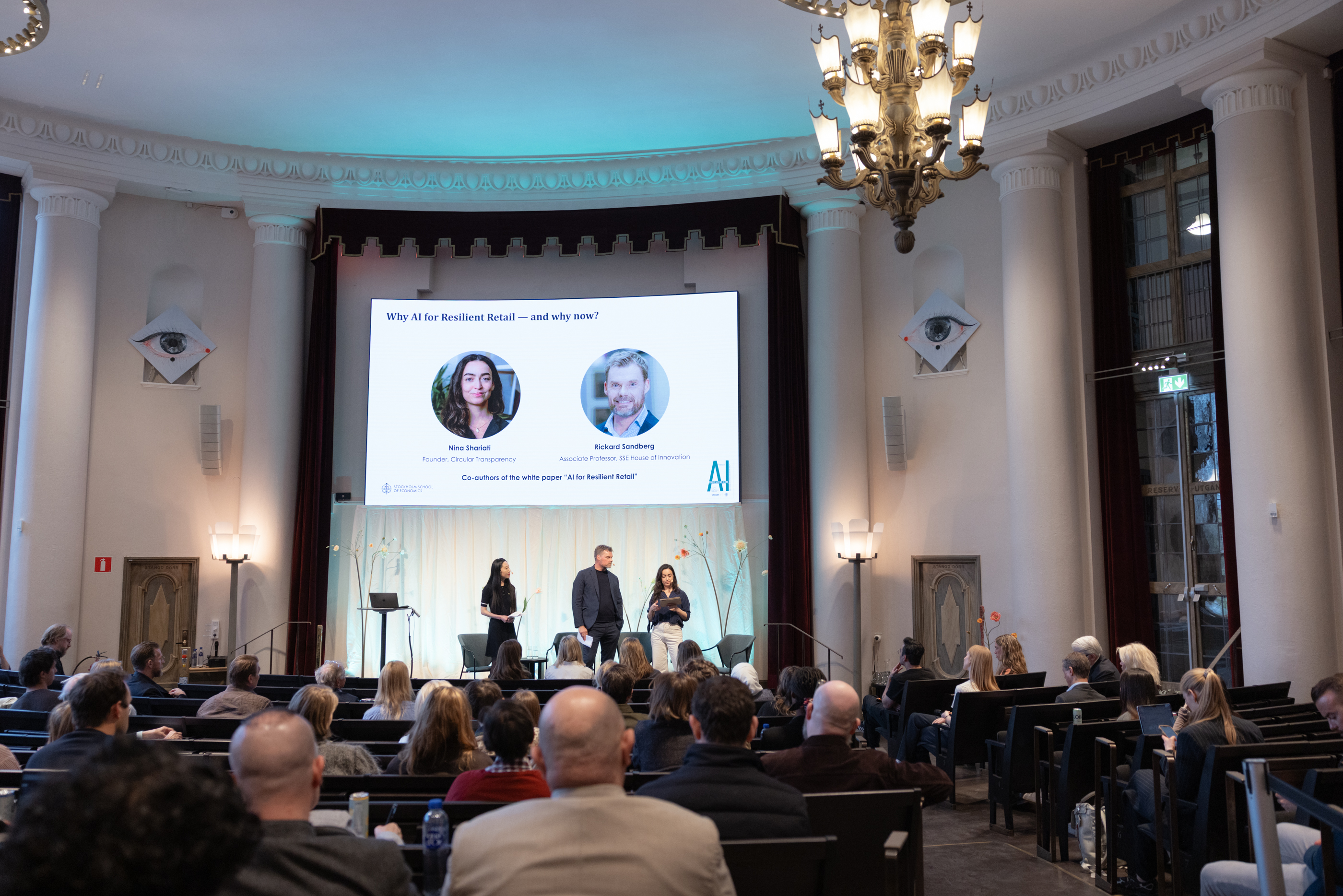 Rickard Sandberg and Nina Shariati welcomed the attendees to the Stockholm School of Economics. Photo: Juliana Wolf
The core argument
Rickard Sandberg opened by setting the broader context. AI is no longer just a set of tools supporting decisions; it is increasingly embedded in how decisions are made and executed across the business.
He described a clear shift over time. The first wave of AI in the 2010s reinforced an existing model built on efficiency and optimization. Forecasting improved, processes became leaner, and organizations were able to operate at greater speed.
What is changing now is the nature of the system itself.
AI is moving from analytical tools to more agentic systems, while the business becomes more interconnected. Decisions across pricing, demand, inventory, and logistics are increasingly linked and moving in real time. This increases both speed and interdependence and fundamentally changes what resilience means.
“This raises new questions about how decisions are coordinated and who is actually in control and accountable as these systems scale,” Sandberg said.
Rather than recovering from disruption, organizations now need to remain coherent as decisions propagate across tightly coupled systems.
 Nina Shariati talked about the AI fragility trap. Photo: Juliana Wolf
At the core of the discussion, Nina Shariati defined the AI fragility trap: when organizations improve performance locally, while the system as a whole becomes harder to steer and less resilient over time.
Many organizations are getting better at AI without becoming better at running their business.
AI can improve performance locally, but it does not automatically strengthen the system. In many cases, it exposes misalignment and scales it. Organizations become more efficient but harder to steer, and more optimized but less adaptable when conditions change.
The issue is not the technology itself but how decisions connect across the business.
When commercial priorities, supply and operations, and capital allocation are not aligned, improvements in one area can create pressure in another. What looks like progress on the surface can increase fragility underneath. This shifts the conversation from technology to leadership.
 Moderator Xuehui "Lily" Gao, Rickard Sandberg, and Nina Shariati. Photo: Juliana Wolf
As Shariati put it, the real question is no longer how much AI an organization has, but whether it is structured to manage the speed, autonomy, and complexity these systems introduce.
Historically, companies have optimized for speed and efficiency, and AI has largely accelerated that model. What is changing is that the same environment now demands something different: the ability to adapt under pressure.
That requires a shift in how leaders think about coordination, governance, and capital allocation, not just optimizing individual parts of the system, but ensuring the business can make coherent decisions as conditions change.

Xuehui "Lily" Gao, Ellen Svanström, Anneli Gunnarsson, and Peter Muld. Photo: Juliana Wolf
Panel one: When AI becomes a leadership question
The first panel focused on governance in practice, with Peter Muld (CIO, ICA), Ellen Svanström (CDIO, H&M Group), and Anneli Gunnarsson (Global VP Retail Data and Machine Learning, IKEA Retail / Ingka Group).
A key theme was the gap between formal governance frameworks and everyday practice. While rules exist, relatively few employees understand their purpose.
Gunnarsson described the challenge at IKEA as helping leaders across a global organization understand the reasoning behind governance decisions, not just the decisions themselves.
“When we come into those conversations, people get it,” she said, “but it is hard to get there.”
 The panelists discussed the challenges of implementing AI at scale. Photo: Juliana Wolf
Svanström described a common pattern. AI has been adopted as a personal productivity tool faster than governance structures have developed. While boards and executives increasingly recognize AI as a strategic issue, traditional approaches, such as prioritizing a small number of use cases as projects, may be insufficient.
“We probably need to do it the other way around,” she said.
On accountability, the panel agreed that responsibility remains with the humans who own the process, regardless of the role of AI. The more complex issue is organizational. Who owns governance when AI systems span multiple functions, and how is that responsibility defined?

Xuehui "Lily" Gao, Hanna Linderstål, Linda Leopold, and Martin Elwin discussed security risks related to AI in the retail sector and beyond. Photo: Juliana Wolf
Panel two: Where resilience strengthens — and where it breaks
The second panel brought together AI Strategic Advisor Linda Leopold, cybersecurity expert Hanna Linderstål, and Martin Elwin, Technology Director for Northern Europe at Amazon Web Services.
Leopold distinguished between AI as a capability and AI as a dependency. Organizations are building dependencies both on a small number of frontier model providers and on AI tools adopted informally by employees. The implications of system changes or disruptions are not yet part of most governance discussions.
She also highlighted the junior talent pipeline as an emerging issue. When AI replaces entry-level tasks, opportunities to build organizational judgment may diminish.
Linderstål, who advises on cybersecurity at an international level, was direct about the current situation. “We are doing this AI race totally headless,” she said. “We have no idea where our data is handled, who is handling it, and how it is being used.”
 The panel agreed that understanding the data is vital before implementing new AI tools. Photo: Juliana Wolf
Linderstål described information as a geopolitical asset and noted that many boards cannot clearly identify where sensitive data is stored. Her recommendation was that organizations understand the value and sensitivity of their data before scaling AI.
Elwin offered an operational perspective. AI provides a layer of technology that can both adapt to environmental change and scale. A forecasting model that adjusts procurement as demand shifts is one example.
Agent-based systems extend this across more variables and with greater complexity, increasing governance requirements. However, organizational readiness (people, processes, and willingness to adapt) remains the main constraint.
 Xuehui "Lily" Gao, Arti Zeighami, Rebecka Löthman Rydå, and Daniel Akenine. Photo: Juliana Wolf
Panel three: Ecosystem dynamics (capital, scaling, and structural advantage)
The final panel took a broader perspective, with Daniel Akenine (National Technology Officer, Microsoft), Rebecka Löthman Rydå (General Partner, Norrsken Evolve), and Arti Zeighami (Senior Advisor AI@Scale, BCG).
On why some organizations scale AI successfully while others remain in pilot stages, the panel emphasized that technology is rarely the main constraint. Zeighami estimated that around 70 percent of outcomes depend on people and processes, while 30 percent relate to technology and data platforms.
Organizations that treat AI as a top-down initiative rather than embedding ownership in business units often struggle to scale.
Löthman-Rydå highlighted Europe’s capital allocation challenge. European pension funds invest roughly 0.1 percent of capital in venture funds, she said, compared to around 10 percent in the United States.
 On request from the audience, the panel ended with positive reflections about the future of AI and business in the Nordics. Photo: Juliana Wolf
Löthman-Rydå also noted that European companies often underinvest in collaboration with startups, where much applied AI innovation takes place.
The participants pointed to infrastructure dependency as a strategic risk. A large share of European AI capacity relies on infrastructure owned by a small number of US companies.
In a geopolitical context where data and platform access can be leveraged, this dependency requires greater attention at the board level.
The discussion concluded with a forward-looking perspective. Stockholm and Sweden, several panelists noted, have structural advantages such as energy supply, technical talent, and a strong entrepreneurial ecosystem that are not yet fully reflected in how the local ecosystem is perceived.
 Rickard Sandberg and Nina Shariati ended the day by sharing a QR code to download their white paper. Photo: Juliana Wolf
Closing reflections
Rickard Sandberg summarized the central question: “The question of whether to adopt AI is settled. The question is how to scale and govern it in a way that builds resilience rather than creating new fragility.”
Nina Shariati concluded by placing the discussion in a broader context. The paper is fundamentally about resilience under structural uncertainty, with AI as a key driver and retail as the environment where these dynamics become most visible.
Retail was chosen because its operational complexity and margin pressure expose these tensions earlier and more clearly. But the underlying shift extends across industries.
She returned to the core tension: organizations are improving performance locally, while the overall business becomes more fragile over time. This dynamic is described as the AI fragility trap.
The key issue is not the extent of AI deployment, but whether organizations can make coherent decisions under pressure.
“This is where the real opportunity lies, for those able to align decisions across the system.”
Curious to learn more? Download the AI for Resilient Retail white paper.
 The attendees gathered in the atrium after the sessions to mingle and enjoy some refreshments. Photo: Juliana Wolf


