What Europe can learn from Ukraine's experience of information aggression

The half-day event explored how influence operations affect economic stability, political legitimacy, and social trust - and what Europe can learn from Ukraine's decade on the front lines.
The event was jointly hosted by the Stockholm Institute of Transition Economics (SITE), the Center for Statecraft and Strategic Communication (CSSC) at SSE, and the Swedish Ukrainian Chamber of Commerce in Scandinavia (SUCC).
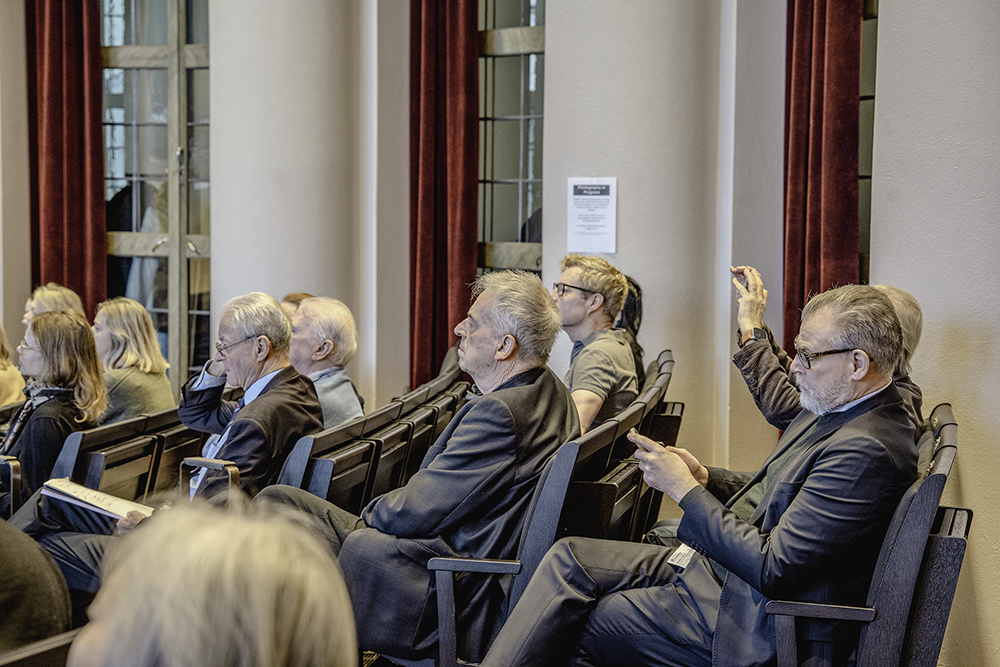
Participants gathered in the Aula at the Stockholm School of Economics for a high-level seminar on antagonistic information threats and lessons from Ukraine. Photo: Johanna Ståhlberg
Information aggression as a strategic challenge
The seminar opened with welcome remarks from Torbjörn Becker, Director of SITE, and Rikard Westerberg, Director of CSSC at SSE. Both emphasized that antagonistic information operations are no longer peripheral communication issues, but central elements of modern geopolitical conflict. They underlined the need to treat information resilience as an economic, institutional, and security priority - not merely as a media or technology issue.
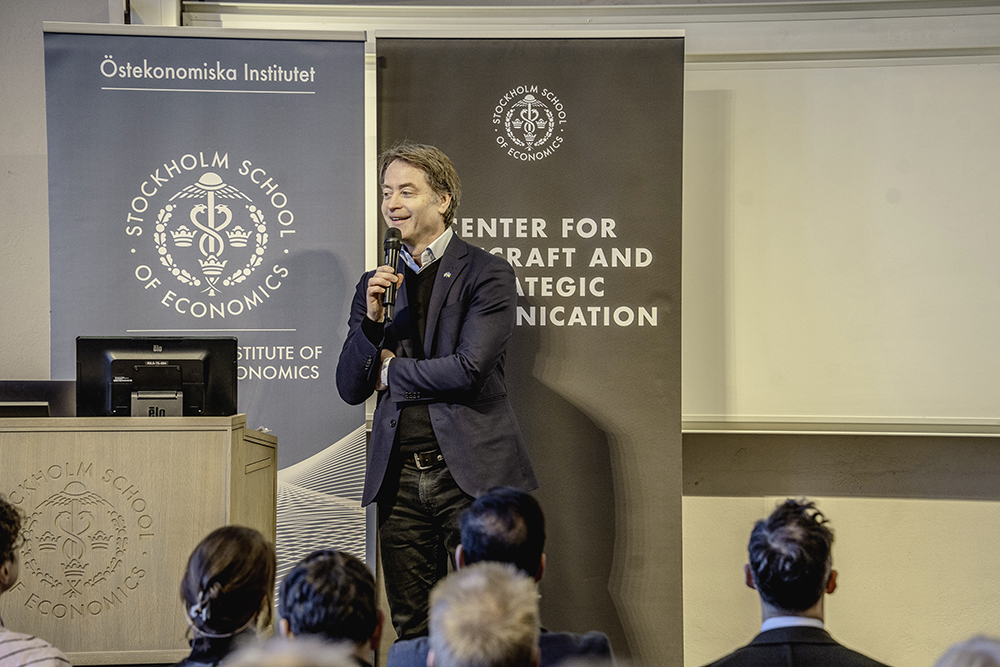
Torbjörn Becker, Director of SITE, opened the seminar by emphasizing the strategic importance of information resilience in modern geopolitical conflict. Photo: Johanna Ståhlberg
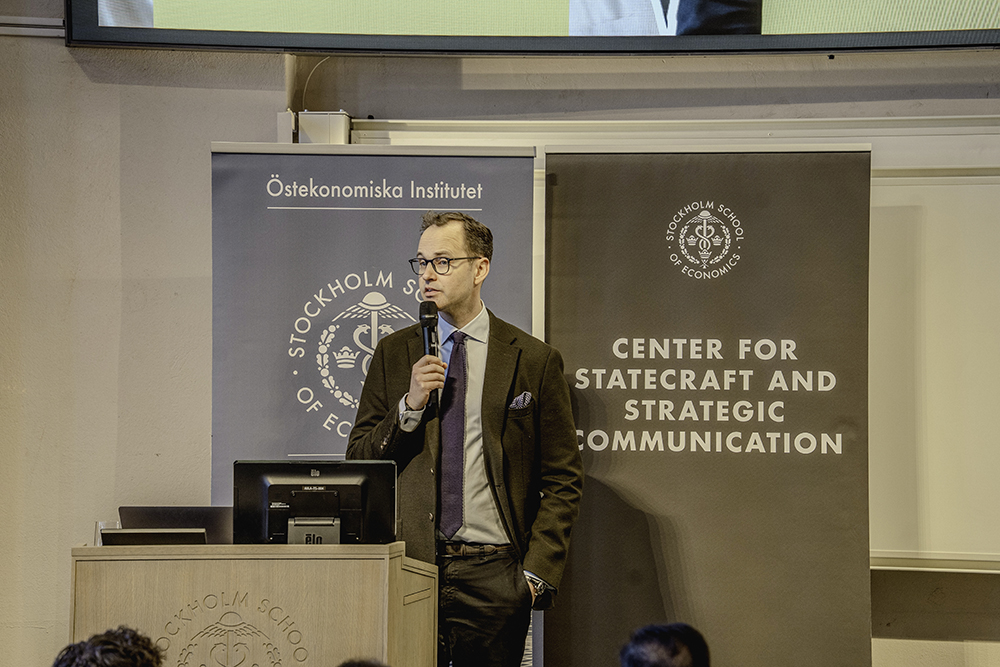
Rikard Westerberg, Director of CSSC at SSE. Photo: Johanna Ståhlberg
Special opening remarks were delivered by Dmytro Gusiev, Political Counsellor and Deputy Head of Mission at the Embassy of Ukraine in Sweden. Drawing on Ukraine's experience, he stressed that information warfare often precedes military escalation.
Narrative manipulation and perception-shaping campaigns, he noted, can influence alliances, delay international responses, and undermine domestic cohesion long before physical conflict becomes visible.
The event was moderated by Anna Anisimova, Researcher at SITE.
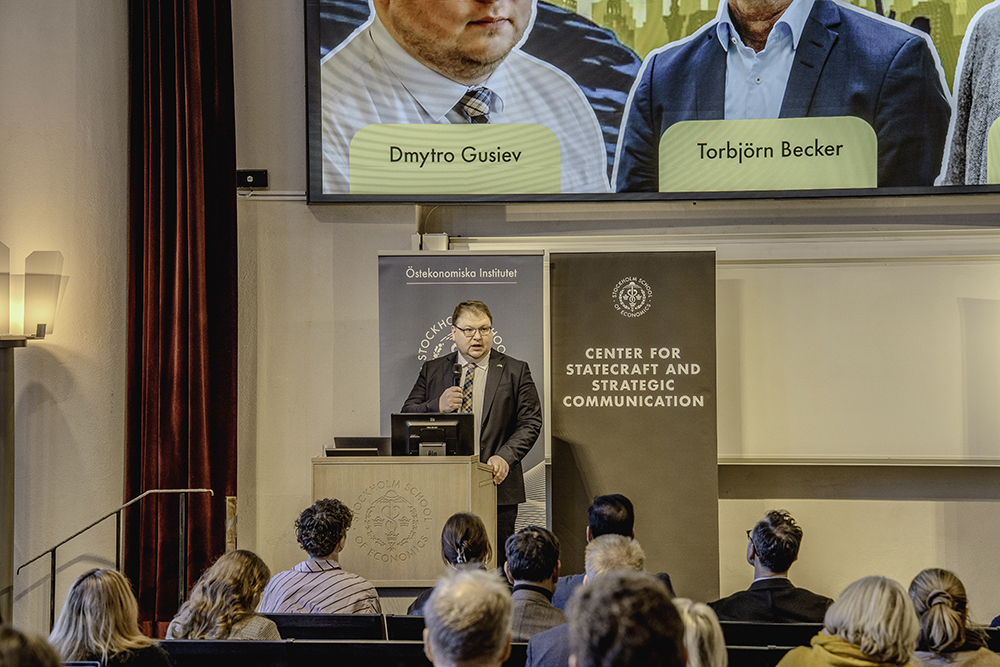
Dmytro Gusiev, Political Counsellor and Deputy Head of Mission at the Embassy of Ukraine in Sweden, highlighted how information warfare often precedes military escalation. Photo: Johanna Ståhlberg
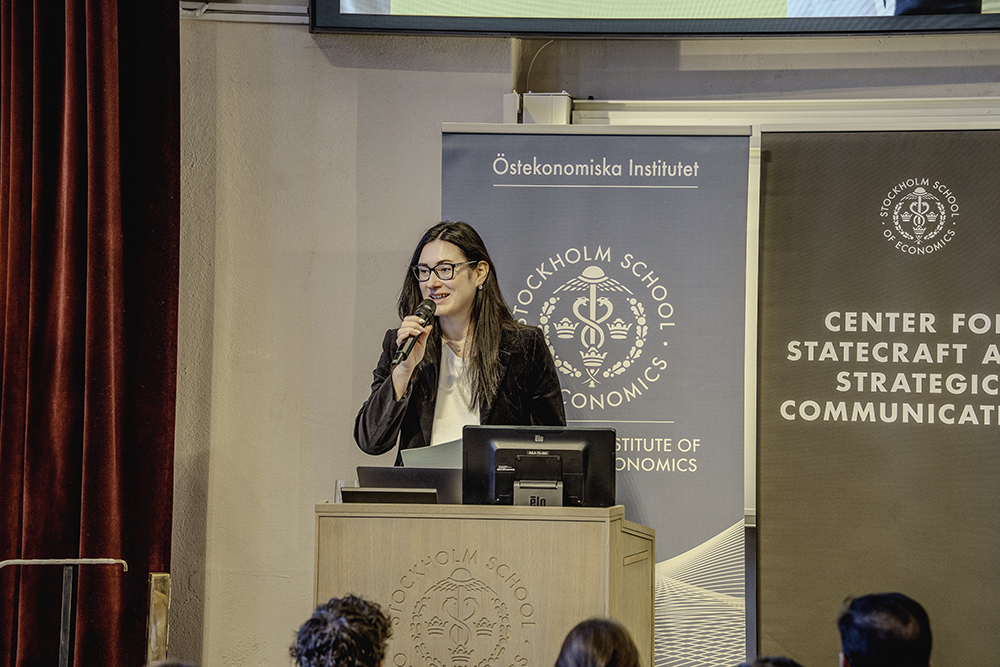
Anna Anisimova (SITE/SSE) moderated the discussion on integrating information resilience into broader security and governance strategies. Photo: Johanna Ståhlberg
Evidence from Ukraine: Narratives, institutions, and behaviour
The keynote speakers provided complementary perspectives on how antagonistic information operations function - and how their effects accumulate over time.
Liubov Tsybulska, Director of the Center for Strategic Communications and Information Security in Ukraine, presented a multi-layered framework for analysing information aggression. Drawing on cases such as Crimea (2014), the MH-17 incident, and the 2022 full-scale invasion, she demonstrated how narrative flooding, dehumanisation, and strategic ambiguity erode trust and fragment alliances. Her central argument was that the decisive battlefield is cognitive rather than territorial - and that trust ultimately determines both vulnerability and resilience.
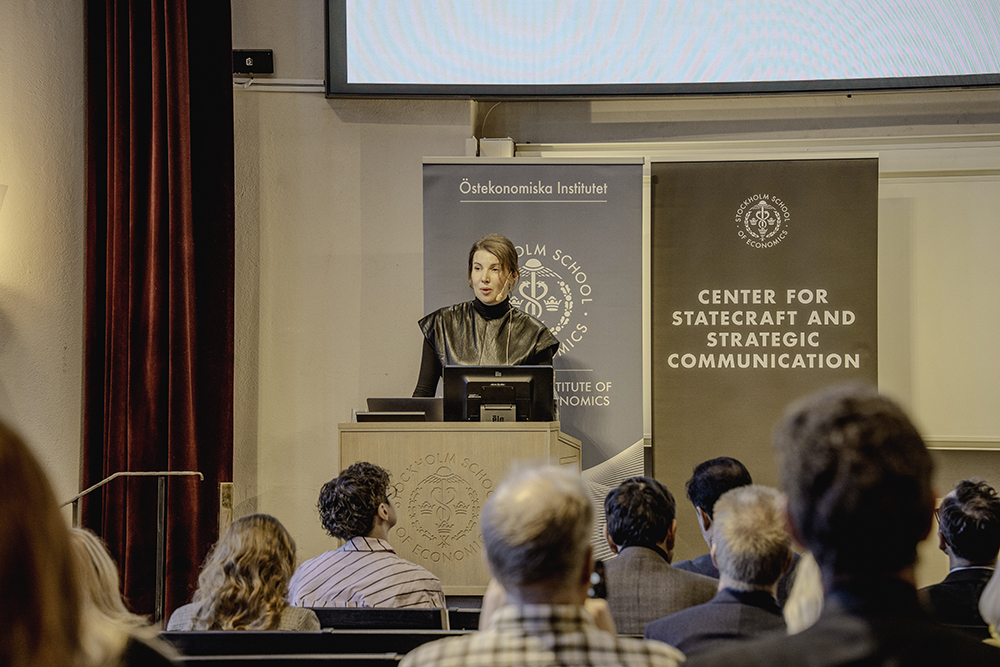
Liubov Tsybulska presented a framework for analysing information aggression, drawing on Ukraine’s experience from 2014 to the present. Photo: Johanna Ståhlberg
Natalia Mishyna, Advisor at the State Service of Special Communications and Information Protection of Ukraine, focused on institutional and technical resilience. She outlined how Ukraine has strengthened digital infrastructure protection, electoral security, and coordinated crisis communication through close collaboration between government agencies and civil society.
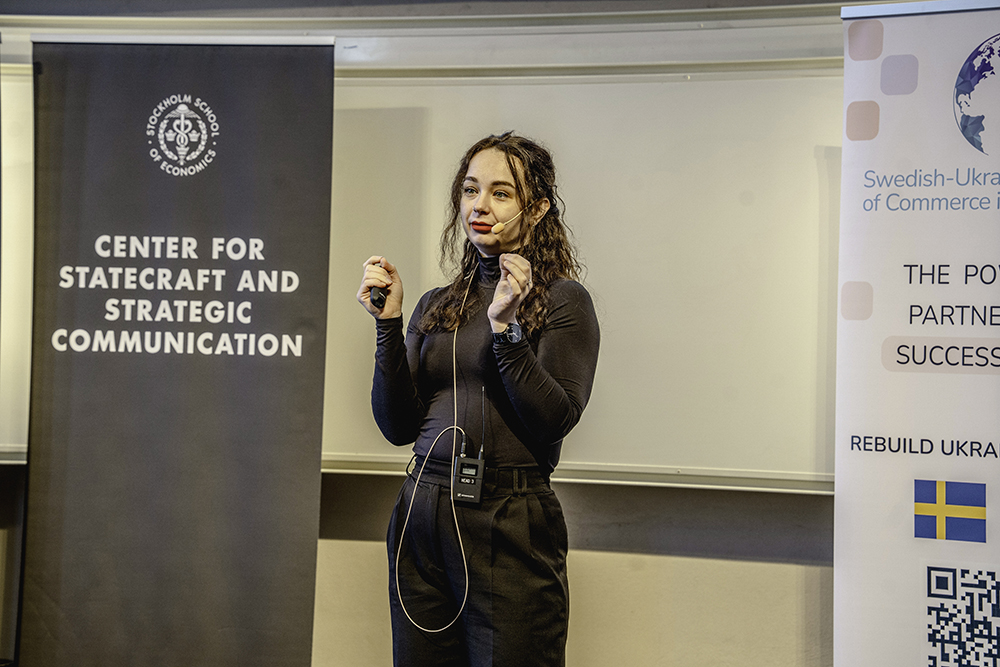
Natalia Mishyna outlined Ukraine’s efforts to strengthen institutional and digital resilience through coordination between government and civil society. Photo: Johanna Ståhlberg
Carlos Diaz Ruiz, Associate Professor at Hanken School of Economics, introduced a behavioural and market perspective. His keynote explored how commercial incentives, media ecosystems, and consumer behaviour interact with political disinformation, creating feedback loops that complicate regulatory and policy responses.
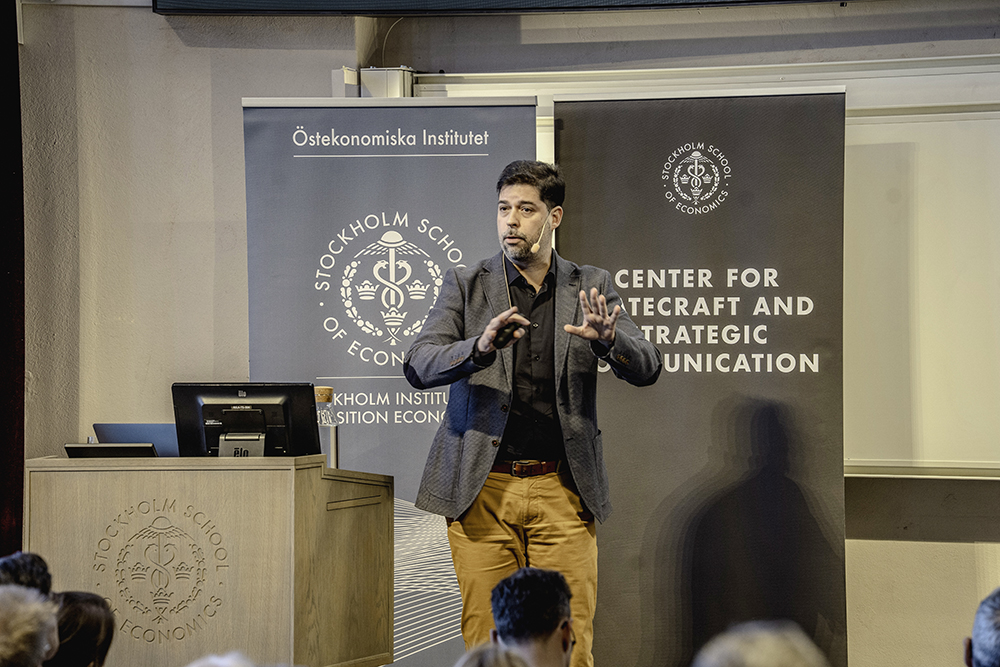
Carlos Diaz Ruiz explored how market incentives and media ecosystems interact with political disinformation. Photo: Johanna Ståhlberg
Key insights: Systemic risks and the centrality of trust
Across keynote presentations and discussions, several shared conclusions emerged:
- Information threats are systemic risks, simultaneously affecting governance, markets, and social cohesion.
- Trust is both the primary target and the main defence asset. Long-term investment in institutional credibility is essential.
- Civil society–state coordination is critical. No single actor can counter hybrid information threats alone.
- International cooperation is indispensable. Disinformation campaigns rarely respect national borders.
- Policy frameworks must evolve continuously alongside technological development and geopolitical change.

An engaged audience followed the discussion closely, contributing questions and documenting key insights from the seminar. Photo: Johanna Ståhlberg
From Ukrainian lessons to European resilience
The panel discussion centered on how Ukraine's experience can inform European policy and practice brought keynote speakers together with Mary Prokhorova, information security and digital communication expert and co-founder of the Nordic-Ukrainian Working Group, and James Pamment, Director of the Lund University Psychological Defence Research Institute.
Key themes included:
- Integrating information resilience into total-defence and security strategies
- Strengthening cooperation between public institutions and civil society
- Aligning regulatory frameworks with rapidly evolving technologies
- Improving cross-border coordination on strategic communication
A recurring theme was that effective responses require not only technical capacity, but also legitimacy, transparency, and public engagement.
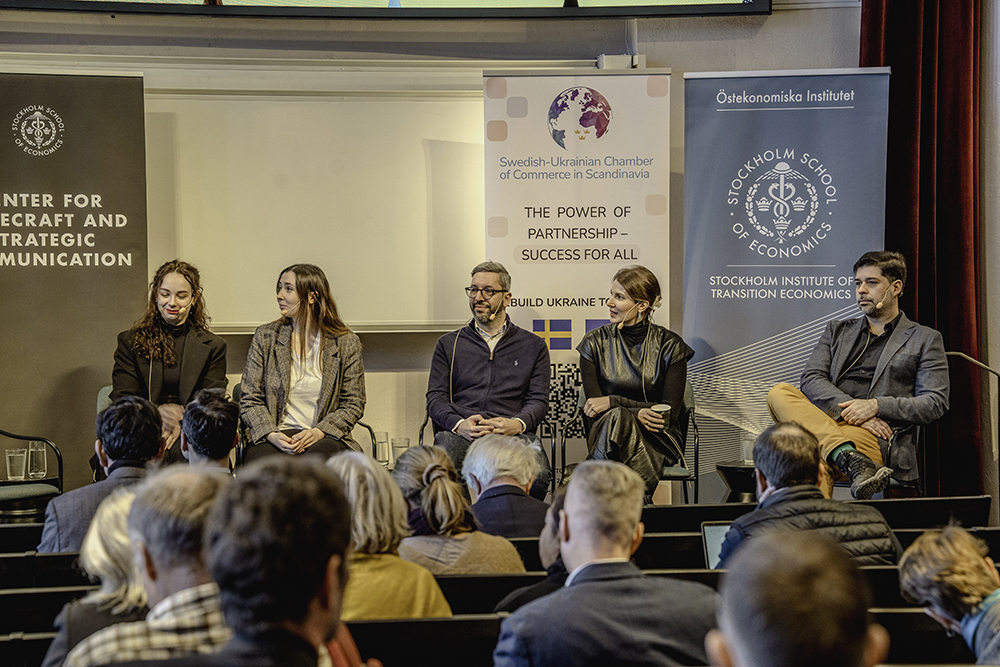
The panel discussion examined how Ukraine’s experience can inform European approaches to information resilience and strategic communication. Photo: Johanna Ståhlberg
Resilience as a continuous process
The event underscored that ignoring antagonistic information threats carries measurable economic and political costs. Ukraine's experience offers a unique evidence base demonstrating that early recognition, coordinated action, and sustained investment in trust-building can significantly reduce long-term damage.
Speakers emphasized that resilience in the information domain is not a one-time intervention, but an ongoing process requiring collaboration between academia, government, business, and civil society.
By convening experts across sectors, the event contributed to a deeper understanding of how democratic societies can strengthen institutional trust and strategic capacity in the face of increasingly complex hybrid threats.
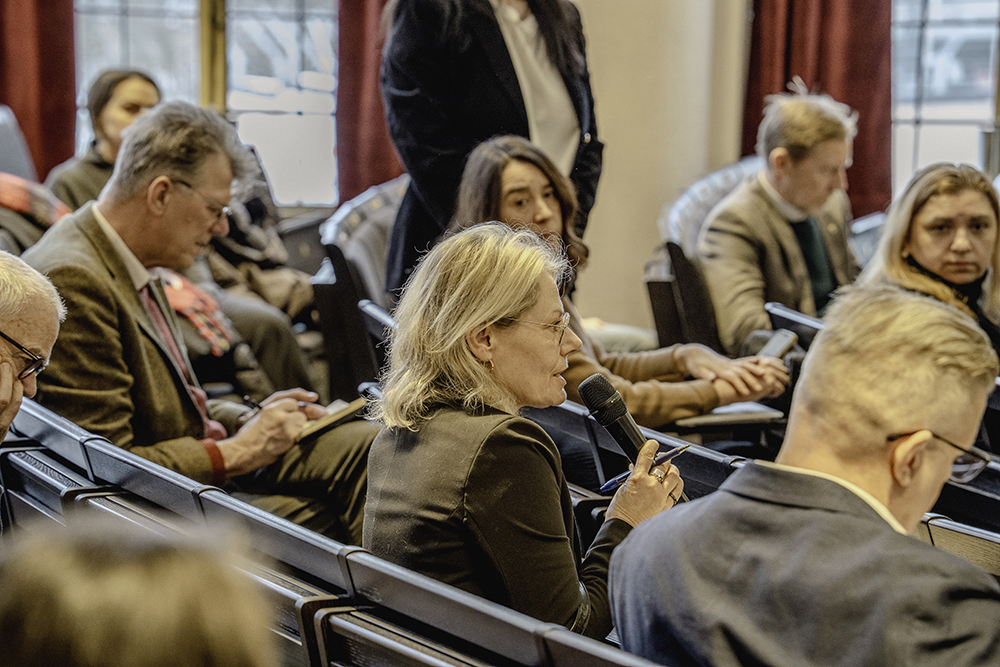
The seminar wrapped up with an engaged Q&A session, where participants raised questions on European resilience, regulatory frameworks, and cross-border cooperation. Photo: Johanna Ståhlberg
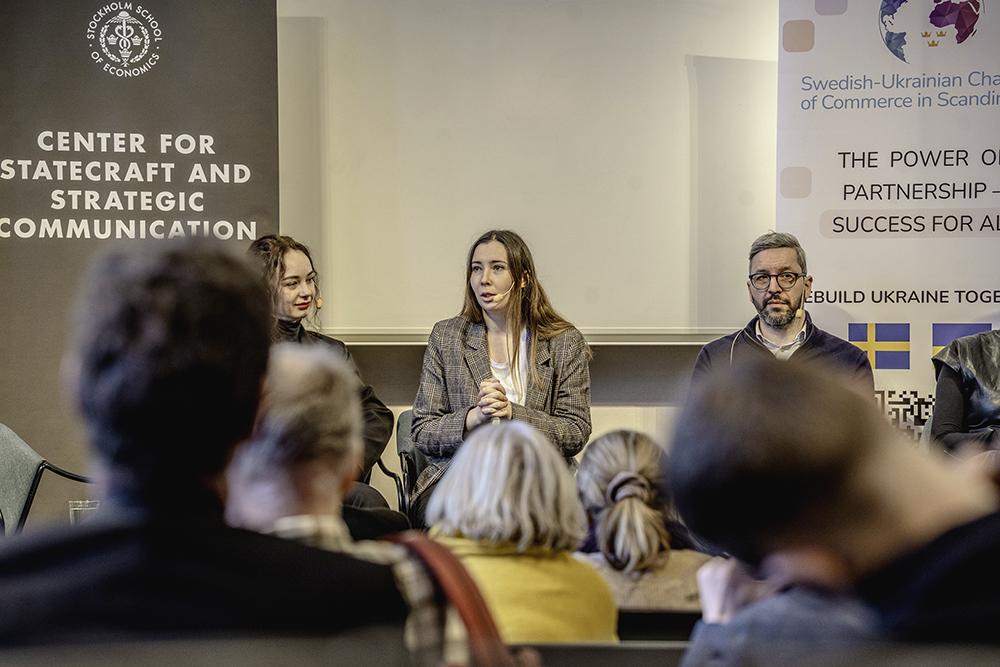
The seminar concluded with continued discussions among participants from academia, policy, and civil society. Photo: Johanna Ståhlberg


