Research Portrait: Constantin Blome

Supply chains are no longer just about efficiency
Supply chains have become strategic weapons; it is time to realize that this goes beyond logistical optimization.
For much of the past three decades, supply chains were treated as instruments of efficiency. Companies stretched production across continents, governments celebrated frictionless trade, and risk was often measured in cost, inventory, and delivery times.
That world has ended.
Constantin Blome, Professor at the Department of Entrepreneurship, Innovation and Technology and affiliated with the Center for Security and Resilience at the Stockholm School of Economics, says the central question is no longer whether global supply chains are vulnerable. It is whether companies and governments are prepared to act on what they already know. Today, supply chains are no longer merely commercial systems. They are instruments of geopolitical power, economic coercion, and national resilience. Semiconductors, pharmaceuticals, critical minerals, energy infrastructure, and space technology have all become part of a wider contest over sovereignty, competitiveness, and security.
“We already know quite a lot about how to avoid supply chain disruptions,” he says. “The challenge is not knowledge. It is implementation.” He compares it to something familiar: “It’s like preventing cavities: you know what to do, but the real challenge is making sure people follow through.”
That distinction matters. In a world of escalating trade tensions, regional conflicts, and strategic dependencies, resilience can no longer be treated as a theoretical ambition or a post-crisis talking point. It has become a core condition for national competitiveness.
From global efficiency to strategic exposure
Blome’s research centers around the intersection of theory and operability, where business, geopolitics, and security now collide. His work examines how global trade and production systems are being reshaped by geopolitical tension and how dependencies between countries, sectors, and firms can quickly become vulnerabilities.
“I’m interested in how resilience can be enhanced,” he says, “but also how supply chains are increasingly being weaponized in geopolitical contexts.”
The consequences are already visible. The blockage of the Suez Canal in 2021 exposed the fragility of global shipping routes. The trade wars between China and the US showed how tariffs, export controls, and industrial policy can reshape corporate strategy almost overnight. The pandemic revealed how quickly shortages in basic goods can become political and social crises. And now the war in Iran has truly shown the geo-economic choke point that is the Strait of Hormuz. Yet many organizations still behave as though the next disruption will resemble the last one.
“The newspapers are full of supply chain crises,” Blome says. “From the Suez Canal to trade wars between China and the US, we are seeing constant shocks. But our systems have not adapted.”
That failure to adapt is no longer just a corporate risk. It is a national one.
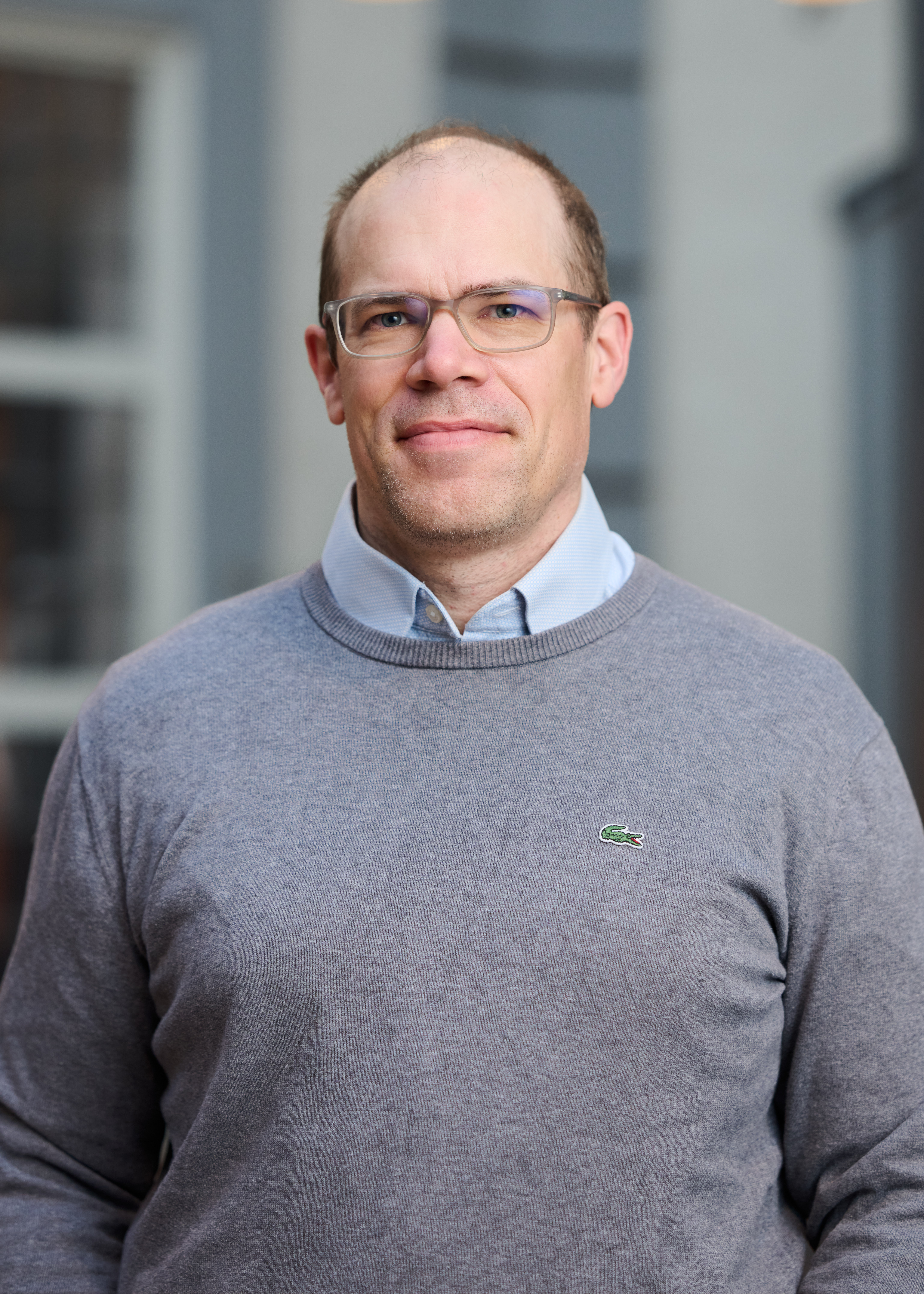
Constantin Blome. Photo: Margareta Bloom Sandebäck
Resilience is built before the crisis
Blome’s interest in supply chain risk began around 20 years ago. While working with a pharmaceutical company that had run out of stock, he saw how operational failure could rapidly become a strategic problem.
“That sparked my interest in understanding how firms manage risk,” he recalls, “and how they can prevent disruptions.”
Since then, repeated crises have sharpened his central argument: resilience is not built by slogans. It is built through decisions, systems, and structures.
Companies may respond impressively once a crisis hits. They reroute shipments, find alternative suppliers, and mobilize emergency teams. But too often, once the pressure eases, deeper reforms are delayed. Inventories remain thin. Supplier bases remain concentrated. Critical dependencies remain poorly understood. The result is a dangerous cycle: shock, response, recovery, complacency.
Blome’s research challenges that pattern. It asks how firms and governments can move from reactive crisis management to proactive resilience, and how they can do so without retreating into protectionism.
“We want trade to continue to flourish,” he says. “But for that, supply chains need to become more resilient.”
The new task: reduce dependency without reducing openness
This is the strategic dilemma now facing Sweden and Europe. Open economies depend on trade. But openness without resilience creates exposure. The task is therefore not to dismantle globalization, but to redesign it for a harsher geopolitical environment.
That means identifying critical dependencies before they are exploited. It means understanding where single suppliers, single countries, or single transport routes create unacceptable risk. It means building redundancy where necessary, diversifying where possible, and coordinating between industry and government in sectors that matter to national security.
At the Center for Security and Resilience, Blome’s work contributes to a broader understanding of how supply chains intersect with national preparedness, competitiveness, and security. The issue is no longer confined to procurement departments. It belongs in boardrooms, ministries, and national security discussions.
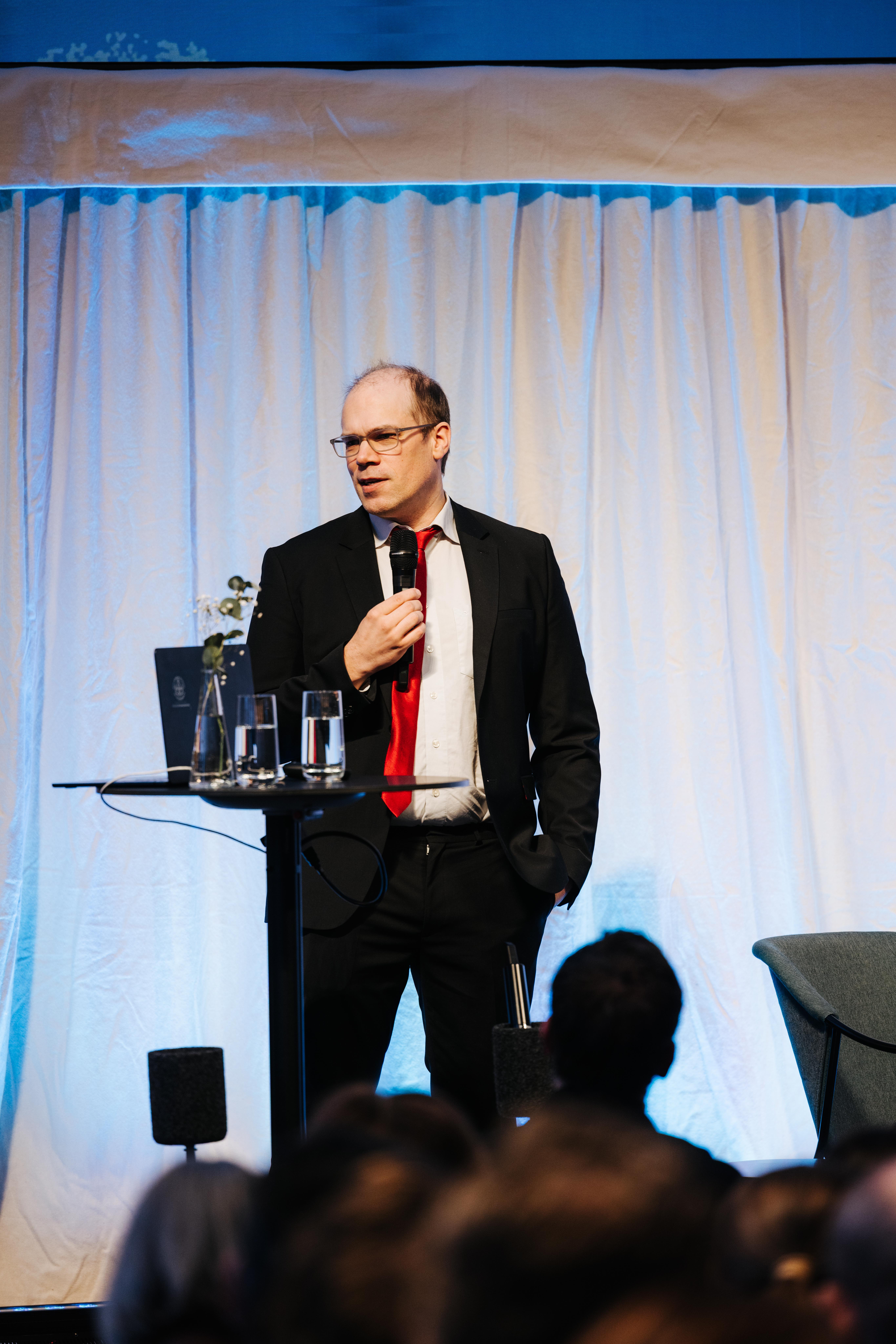
Constantin presenting his new Center for Transformative Innovation at our high level symposium on “Driving and governing the green transition” at SSE in February. Photo: Juliana Wiklund
This is where research can have immediate impact.
“I find it most rewarding that our research can be implemented,” Blome says. “The divide between academia and practice is relatively small in our field.”
That practical orientation has shaped his career. Before joining the Stockholm School of Economics, Blome held senior academic positions across Europe, including as Dean at Lancaster University Leipzig and chaired professorships in Belgium and the UK. Throughout, he has remained closely connected to industry, working with companies on the problems that define modern supply chains.
Why this matters now
For Sweden and Europe, the stakes are rising. Supply chains underpin defense production, green transition technologies, healthcare systems, food security, digital infrastructure, and industrial competitiveness. A weakness in any one of these areas can quickly become a strategic liability.
Blome’s research points to a clear conclusion: resilience is not the opposite of efficiency. It is the precondition for sustainable competitiveness. The countries and companies that understand this first will be better placed to withstand shocks, protect critical capabilities, and continue trading in a more volatile world. Those that do not may find that dependencies built in times of stability become constraints in moments of crisis.
But the professional message is urgent and direct. Supply chains have moved from the background of globalization to the center of geopolitical strategy. Treating them as technical systems is no longer enough.
The challenge now is to act before the next crisis exposes what should already have been fixed.
A simple insight with complex implications
If he had to summarize his research in one message, it would be this:
“We already know quite a lot to avoid supply chain disruptions and how to increase resilience in supply chains, but we need to respect the principles and establish standards.”
He compares it to something familiar:
“Similiar to caries, it’s easy to know how to prevent it, but the trick is to find mechanisms that your kids really respect the rules. This needs a multilevel effort to help societies to better protect against disruption impact.”
Want to learn more?
For more information regarding the research at the Center for Security and Resilience please contact Executive Director Staffan Holmberg at staffan.holmberg@hhs.se
You can follow Constantin Blome’s research on Google Scholar, connect with him on LinkedIn, or contact him directly at:
About the Research Portrait series
The Research Portraits series highlights the people behind the research at the House of Governance and Public Policy (GaPP) and its centers. Each portrait offers a closer look at a researcher’s work, background, and motivations - showing not only what they study, but also why it matters.


