Sarah Philipson Isaac nominated for national sociology prize

Sarah Philipson Isaac, postdoctoral researcher at the Center for Migration and Integration Research (CMIR) at the Stockholm School of Economics, was among the nominees for the Swedish Sociological Association’s prize for best doctoral thesis in sociology. The prize was awarded to another researcher.
“In an increasingly repressive political climate marked by the erosion of asylum rights through policies like the EU Pact on Migration and Asylum, as well as broader authoritarian developments, ongoing war, genocide and violence - critical scholarship plays a vital role. It helps us name and challenge the structures that normalize exclusion, dispossession, and devaluation of life”, says Philipson Isaac.
Her dissertation, Temporal Dispossession: The Politics of Asylum and the Remaking of Racial Capitalism in and Beyond the Borders of the Swedish Welfare State, examines how Sweden’s post-2015 shift to temporary residence permits has reconfigured asylum governance by institutionalizing uncertainty as a condition of life for those seeking asylum. Centering time as a key analytical lens, the study shows how temporality itself operates as a mechanism of control—structuring access to rights, shaping labor market participation and redistributing vulnerability and life chances.
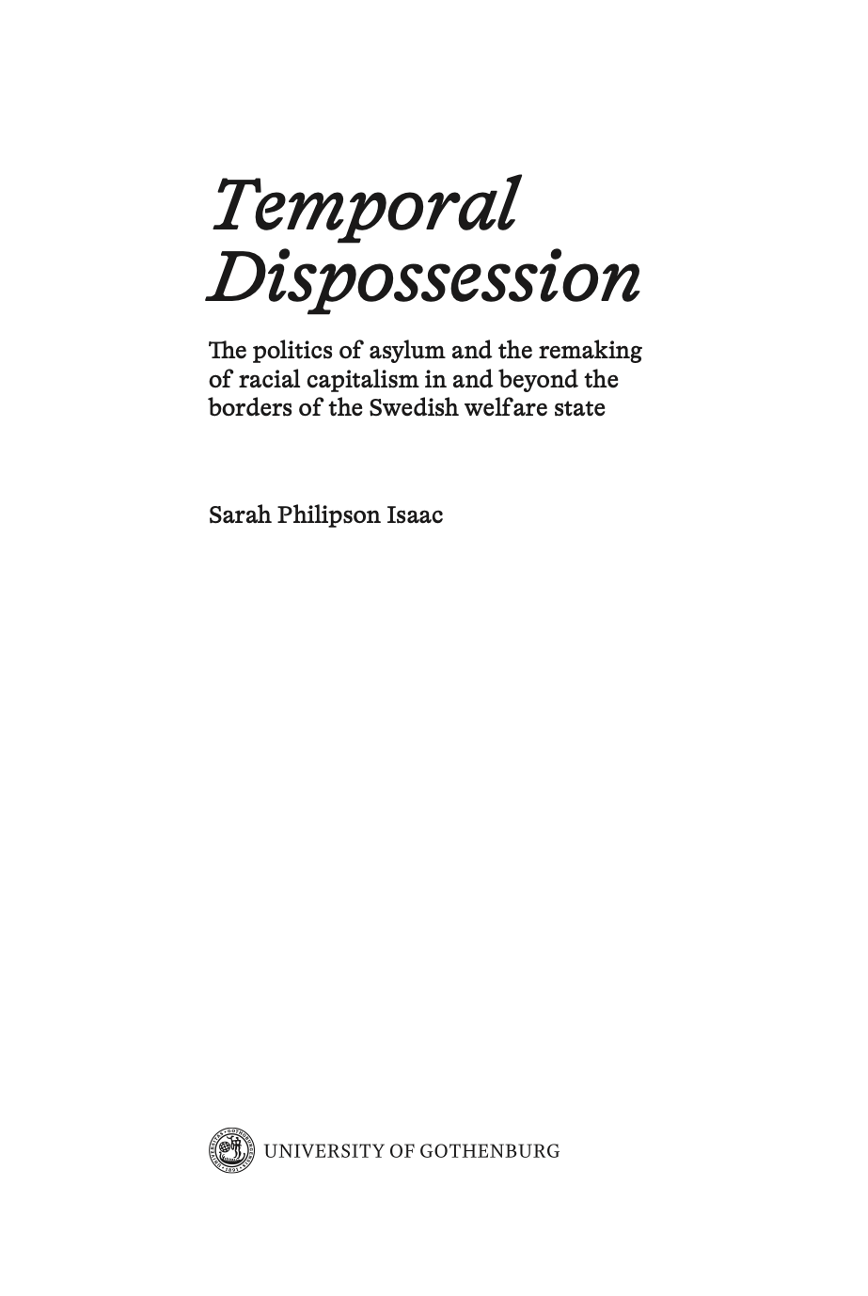
Book design and typesetting: Alexandra Papademetriou
Drawing on the framework of temporal dispossession, the dissertation analyzes how the regulation of time produces differentiated forms of dispossession that are closely tied to the logics of racial capitalism, including differentiation, devaluation, and competition. Based on four years of ethnographic research with people seeking asylum and key actors within migration institutions, it traces how bureaucratic processes, legal precarity and labor market conditionality work together to render certain populations deportable, exploitable, and permanently provisional.
The work has also received a special mention from the Swedish Association for Labor Studies (FALF) in 2025, recognizing its importance for working life research in Sweden. The distinction highlights its contribution to understanding how inequality is produced across migration and labor market contexts.
Together, these recognitions underline the significance of Philipson Isaac’s research at the intersection of migration, labor, and inequality.


