
Is It Time for Sweden to Join the Euro? A New Anthology Revisits the Debate
Mar. 23, 2026
More than two decades have passed since Sweden voted to remain outside the euro. Since then, the economic and political landscape in Europe has changed substantially, prompting renewed debate about the costs and benefits of joining the currency union.
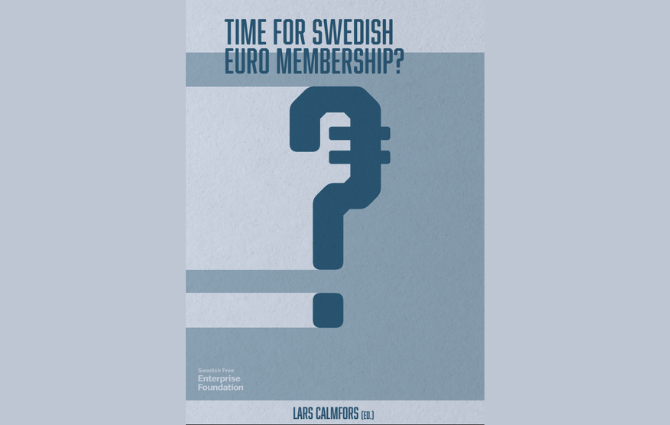
In the anthology Dags för euron? (Time for the Euro?), edited by Lars Calmfors (Stockholm University) and first published in Swedish in December 2025, fourteen economists and political scientists reassess what euro membership would mean for Sweden today. The text was recently translated into English, making the analysis accessible to a broader international audience.
International Interest in a National Debate
Calmfors explains that the decision to translate the anthology into English was motivated by clear international interest. According to media coverage tracked by Institutet för Näringslivsforskning (Research Institute of Industrial Economics), the book has attracted attention in several European countries, and institutions such as the European Commission and the IMF have also expressed interest.
Calmfors notes that, in recent years, there have been few comprehensive evaluations of the costs and benefits of euro membership, suggesting strong academic and policy interest in the topic, particularly in EU countries outside the euro area, including Denmark, Poland, Romania, the Czech Republic, and Hungary, as well as in countries such as Iceland, Norway, and the United Kingdom.
“This book shows that the euro debate should be revisited with fresh evidence and without preconceived conclusions,” Calmfors says.
The project was led by Calmfors, who also chaired Sweden’s Economic and Monetary Union (EMU) Inquiry in 1996, and was carried out with full academic independence on behalf of the Swedish Free Enterprise Foundation (Stiftelsen Fritt Näringsliv). Drawing on new research and current policy challenges, the contributors examine both the potential benefits and the risks of joining the euro in a markedly different European and Swedish context.
Monetary Policy Under the Euro
Swedish House of Finance (SHoF) researchers contribute chapters analyzing how euro adoption could affect Sweden’s monetary policy, financial stability, and political influence within the European Union.
Karl Walentin’s (SHoF/Uppsala University) chapter examines how the Riksbank’s monetary policy compares with that of the European Central Bank (ECB) and asks a crucial question: How much better will independent monetary policy be for the Swedish economy?
His assessment shows that while interest rate differences are often small, having national control becomes especially valuable during Sweden-specific or severe economic shocks. With Swedish households highly sensitive to interest rates and several Euro area countries constrained by higher debt levels across the euro area, ECB’s monetary policy could be too expansionary for Sweden in downturns.
“Sweden’s interest-sensitive economy benefits from being able to respond quickly and forcefully to shocks,” says Karl Walentin. “A one-size-fits-all monetary policy would make this considerably harder.”
Financial Markets and the Banking Union
In their chapter, Peter Englund (SHoF/SSE) and Pehr Wissen (SHoF) analyze how Sweden’s financial sector would be affected by euro adoption and entry into the banking union. They found that removing currency conversion and hedging costs would bring some efficiency gains, but these are modest compared with the broader strategic question of how membership would reshape Sweden’s influence over future EU financial regulation and the evolution of European capital markets.
“The direct financial-market gains from adopting the euro appear limited, largely because Sweden is already deeply integrated with EU markets,” Englund notes. “The real issue is how membership would shape Sweden’s influence over future financial regulation and the development of Europe’s capital markets.”
Wissén adds: “Sweden has one of the EU’s largest financial sectors relative to GDP, while at the same time having one of the EU’s smallest currencies. In a crisis, that is a particularly unfortunate combination. Joining the euro would shift some supervisory responsibilities to the ECB, reducing national control in certain areas, but it could also strengthen Sweden’s voice in EU-wide decisions. Ultimately, the long-term impact depends on whether we value greater influence over the financial architecture of the union.”
Beyond Policy Silos
Looking beyond specific policy areas, Stefan Ingves (SHoF) reflects on the broader practical consequences of joining the euro. He argues that Sweden should adopt the currency, noting that Sweden and the euro area already in economic terms move closely together and that Sweden can meet the convergence criteria with relatively limited adjustments. He also points out that membership could strengthen Sweden’s influence in European financial decision-making, reduce vulnerabilities tied to managing a small independent currency, and align with a financial infrastructure that is increasingly de facto European.
“From a practical perspective, Sweden already functions, or is about to function, as part of a European financial system,” Ingves says. “Joining the euro would formalize this reality and give us a stronger voice in shaping the rules we increasingly live by.”