
• Login
  • Contact
  • About
    • Objectives
    • Organization
    • People
    • Partners
    • Job opportunities
    • Annual reports
    • Women in Finance
  • Research
    • Academic Seminars
    • Publications
    • Research in the spotlight
    • Disclosure policy
  • National PhD program
    • Core courses
    • Mini courses
    • PhD visitor program
    • National PhD Workshops
    • PhD Seminars
    • Job market candidates
    • PhD Placements
  • Outreach
    • Academic seminars
    • Conferences
    • Industry seminars
    • Videos
    • Podcasts
    • News & press
      • News
      • In the press
      • Newsletters
    • Data Visualizations
  • Data Center
    • SHoF Data center – a national mission
    • Fama French Factors
    • FinBas
    • Historical Archives
    • NASDAQ HFT
    • Nordic Compass, SHoF's ESG Database
    • PAtLink
    • Serrano
    • SHoF Fund Data Morningstar
    • News
  • About
    • Objectives
      • Our guiding principles
    • Organization
      • Board
      • Management committee
      • SHoF advisory board
      • Scientific advisory board
      • Department of Finance SSE
    • People
      • Resident researchers
      • Academic partner visitors
      • Affiliated researchers
      • Postdoctoral fellows
      • Research assistants
      • Job market candidates
      • PhD students
      • Admininistration
      • Outreach
      • Data center
      • Advisors
    • Partners
      • Academic partners
      • Partners
    • Job opportunities
    • Annual reports
    • Women in Finance
      • Events
      • Videos & podcasts
      • Featured research
      • News & press
      • Women in Finance Data
  • Research
    • Academic Seminars
    • Publications
    • Research in the spotlight
    • Disclosure policy
  • National PhD program
    • Core courses
    • Mini courses
    • PhD visitor program
    • National PhD Workshops
    • PhD Seminars
    • Job market candidates
    • PhD Placements
  • Outreach
    • Academic seminars
    • Conferences
    • Industry seminars
    • Videos
      • Interviews by Swedish House of Finance
      • SNS/SHoF Finance panels videos
      • Seminar videos
      • Conference videos
      • Annual Conference videos
    • Podcasts
    • News & press
      • News
      • In the press
      • Newsletters
    • Data Visualizations
      • Why the Rich Get Rich: New Research Shows It’s About Risk Attitudes and Patience
      • The SUSY Monitor
      • How Financial Education Transformed Corporate Decision-Making in Mozambique
      • Does Carbon Pricing Work? Evidence from Swedish Firms
      • Designing a Carbon Tax Policy That Works
      • Women in Finance Data
      • WIF 2025
  • Data Center
    • SHoF Data center – a national mission
      • Terms and conditions
    • Fama French Factors
    • FinBas
      • Stocks Timeseries
      • Indices Timeseries
    • Historical Archives
      • Stocks list archive
      • Annual reports archive
      • Affärsvärlden Archive
      • Owners and Power
    • NASDAQ HFT
      • Reconstructed Order Book
      • Nordic Market Quality
    • Nordic Compass, SHoF's ESG Database
    • PAtLink
    • Serrano
    • SHoF Fund Data Morningstar
      • Valuations: Daily TNA and net flow by fund and fund share class
      • Re-invested Prices: Dividends re-invested prices
      • Splits: Fund split date and split ratio
      • Dividends: Fund dividends
      • Prices: Fund daily prices
    • News
  • Login
  • Contact
  • Swedish House of Finance
  • Outreach
  • News & press
  • News
  • Can Bank Regulation Be Simpler Without Being Weaker?
Swedish House of Finance
  • About
  • Research
  • National PhD program
  • Outreach
    • Academic seminars
    • Conferences
    • Industry seminars
    • Videos
    • Podcasts
    • News & press
      • News
      • In the press
      • Newsletters
    • Data Visualizations
  • Data Center

Can Bank Regulation Be Simpler Without Being Weaker?

Apr. 01, 2026

The banking sector is still adapting in the years following the global financial crisis. Since then, capital requirements have been strengthened in Sweden and internationally to make the financial system more resilient and reduce systemic risk. At the same time, policymakers are now debating how to simplify and update these rules, with some countries considering making parts of the regulatory framework less stringent to reduce complexity and improve competitiveness.
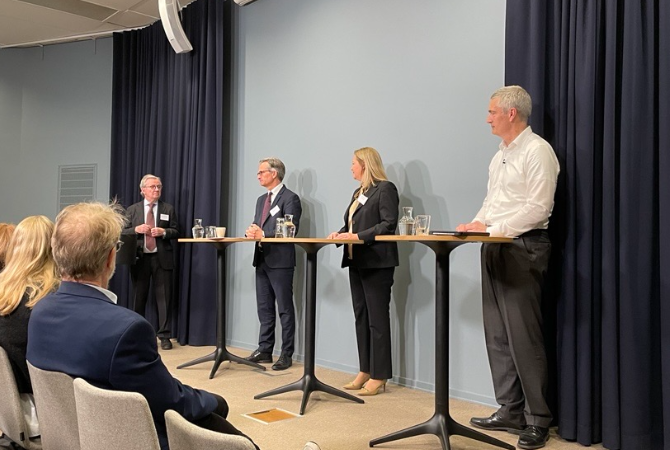
At a seminar hosted by SNS Center for Business and Policy Studies (SNS), Sveriges Riksbank and Swedish House of Finance (SHoF), Erik Thedéen, Governor of the Riksbank, Linda Fagerlund, CEO of Danske Bank Sweden, and Kasper Roszbach, Professor of Economics at Lund University, discussed the future direction of bank capital regulation.

Balancing Simplicity and Stability in a Changing Risk Landscape

As of April 1, new macroprudential measures have come into force in Sweden, including changes to amortization requirements and the transfer of responsibility for the countercyclical capital buffer from Finansinspektionen to the Riksbank. Thedéen noted stronger capital requirements have been central to improving the resilience of the financial system since the financial crisis.

“The buffer has proven to be an effective tool, not only for managing financial cycles, but also for responding to external shocks.”

He said the buffer should be built up in periods of economic strength and released during downturns to support lending. Without such mechanisms, banks may reduce credit supply in ways that amplify economic stress.

Thedéen also pointed to concerns about the growing complexity of the regulatory framework. He argued that a simpler and more transparent regulatory framework could strengthen both understanding and stability, while stressing that efforts to simplify regulation must not lead to deregulation.

He added that regulatory frameworks need to continue evolving in response to emerging risks.

“At the same time, regulations must continue to evolve. New risks are emerging, not least in connection with non-bank financial institutions, private credit, and crypto-assets.”

European Banks Face Pressure as Global Rules Diverge

Fagerlund outlined the banking sector’s perspective, focusing on implementation and competitiveness. She described the countercyclical capital buffer as an effective tool that enabled banks to continue lending during periods of stress.

She also highlighted the importance of reciprocity, noting that banks operating across borders require consistent regulatory conditions. The transfer of responsibility for the buffer to the Riksbank was viewed positively, though she emphasized the need for coordination between authorities.

Fagerlund said Nordic banks operate in a global market while facing relatively high capital requirements, underscoring the need for simpler and more predictable rules. She added that regulatory frameworks must adapt to new risks, including technological change, climate-related factors, and cyber threats, while supporting investment in areas such as infrastructure, energy, and defense.

“We are convinced that banks have an important role to play in meeting the major investments and challenges that come with a rapidly changing global landscape. To succeed, a stable and simple regulatory framework is required, one that supports growth, innovation, and fair competition, while safeguarding financial stability.”

She also pointed to increasing competitive pressure from U.S. banks and warned that regulatory easing in the United States and the United Kingdom could affect the position of European lenders.

Research Highlights the Role of Capital, Data Gaps and Global Risks

Kasper Roszbach provided an academic perspective, focusing on three key questions: what problem regulation is intended to solve, what has been learned from post-crisis reforms, and how international implementation shapes outcomes.

He emphasized that banking crises have long-lasting and severe effects, particularly for banks themselves, and that liquidity support alone is insufficient to address systemic stress. Strong capital buffers are therefore essential.

Research that he presented showed that higher capital requirements generally improve financial stability without harming the real economy, as credit can shift between institutions. In some cases, higher capital levels are even associated with lower funding costs and stronger credit growth. At the same time, he cautioned that rapid increases in capital requirements during periods of stress can have negative effects.

Roszbach also highlighted significant knowledge gaps, particularly regarding risks outside the traditional banking sector. Non-bank financial institutions remain a “blind spot” in both data and regulations.

Finally, he raised concerns about developments in the United States, where proposals point toward lower capital requirements and reduced supervisory capacity. This could increase global systemic risks and potentially trigger a “race to the bottom.”

He concluded by emphasizing the need for better data, stronger evaluation frameworks, and broader regulatory coverage, including non-bank actors, to ensure effective and resilient financial regulation.

Key Takeaways

- Simpler rules must not mean weaker rules

- Capital buffers remain a critical tool

- Regulation must evolve with new risks

- Global competition is shaping the debate

- Knowledge gaps and data limitations persist

The full presentation:

Erik Thedéen, Governor of the Riksbank

In Swedish: Thedéen: Trender i kapitalregler för banker

Read more

Simplification is important, but it must never become an excuse for deregulation.”
Erik Thedéen
Event March 31, 2026

What should future capital requirements for banks look like?

Read more

  • About
    • Objectives
    • Organization
    • People
    • Partners
    • Job opportunities
    • Annual reports
    • Women in Finance
  • Research
    • Academic Seminars
    • Publications
    • Research in the spotlight
    • Disclosure policy
  • National PhD program
    • Core courses
    • Mini courses
    • PhD visitor program
    • National PhD Workshops
    • PhD Seminars
    • Job market candidates
    • PhD Placements
  • Outreach
    • Academic seminars
    • Conferences
    • Industry seminars
    • Videos
    • Podcasts
    • News & press
      • News
      • In the press
      • Newsletters
    • Data Visualizations
  • Data Center
    • SHoF Data center – a national mission
    • Fama French Factors
    • FinBas
    • Historical Archives
    • NASDAQ HFT
    • Nordic Compass, SHoF's ESG Database
    • PAtLink
    • Serrano
    • SHoF Fund Data Morningstar
    • News

Swedish House of Finance

Bertil Ohlins gata 4, 113 50 Stockholm

info@houseoffinance.se +46 8 736 91 00
Subscribe