
How Do Institutions Form Return Expectations? Research Sheds Light on Beliefs, Risk Premia, and Portfolio Choice
feb. 18, 2026
At a recent breakfast talk hosted by the Swedish House of Finance (SHoF), Magnus Dahlquist (SHoF/SSE) presented new research examining how institutional investors form expectations about future returns and how those expectations shape portfolio decisions across asset classes and over time.
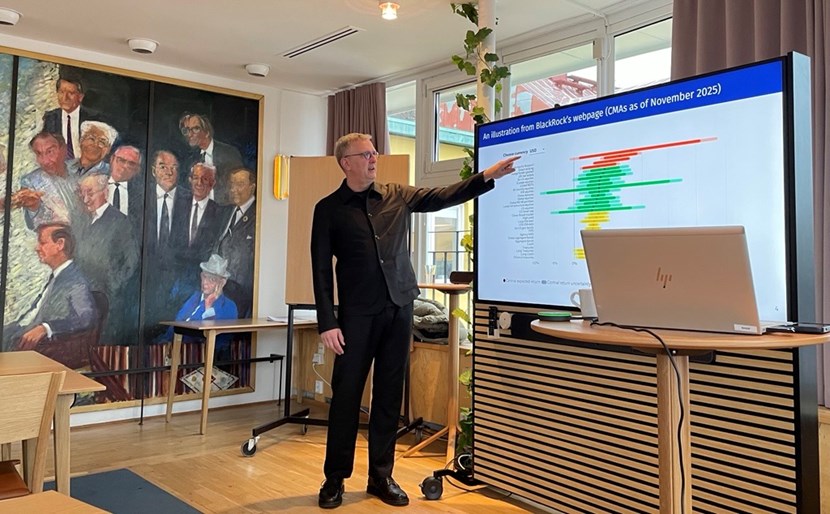
Return expectations sit at the heart of long-term institutional investing. Asset managers, public pension funds, investment consultants, and professional forecasters all publish capital market assumptions that guide allocation decisions worth billions. Yet relatively little is known about how these expectations are formed, how they differ across institutions, and how closely they align with objective measures of risk.
How Are Return Expectations Formed?
Drawing on joint research with Markus Ibert, Dahlquist studies institutional investors’ subjective risk premia, the returns above risk-free proxies they expect to earn for bearing risk.
The findings show that subjective risk premia move closely with simple measures of objective risk premia. Expected equity and credit risk premia tend to be countercyclical, rising during recessions and falling during expansions.
“Our evidence shows that institutional investors’ subjective risk premia vary almost one-to-one with objective measures of risk premia,” Dahlquist noted.
Why Do Expectations Differ Across Institutions?
While expectations move with the business cycle, the research finds that differences across institutions are more pronounced than changes over time. In other words, persistent heterogeneity in beliefs plays a larger role than shifting macroeconomic conditions.
Part of this variation appears linked to disagreement about long-term valuation levels. Even among sophisticated institutional investors, views on fair value and long-run returns differ meaningfully.
“We see more variation across institutions than across time,” Dahlquist explained. “That suggests persistent differences in beliefs, not just temporary reactions to market conditions.”
Do Expectations Actually Shape Portfolios?
A key question is whether stated expectations translate into actual investments. The study finds that they do. Asset managers that expect higher risk premia in equities tend to allocate more capital to equities and less to other asset classes.
The estimated sensitivity of portfolios to expectations is stronger than what previous studies have documented for retail investors. However, the relationship is muted by institutional constraints such as mandates and regulatory limits. Even so, portfolio responses remain smaller than what a standard frictionless portfolio choice model would predict.
Dahlquist emphasized that understanding these dynamics is crucial for both academes and practitioners. In addition to his academic work, he serves on several boards and investment committees, including the Expert Council to the Norwegian Ministry of Finance for the Government Pension Fund Global (the “oil” fund) and an expert group evaluating Denmark’s ATP investment strategy. Dahlquist expressed his appreciation for the strong link between research in finance and practice.
By providing systematic evidence on institutional return expectations and their link to portfolio choice, the research highlights the central role of beliefs in shaping capital allocation. As market conditions evolve, understanding how institutions form, and act on, their expectations will remain key to interpreting movements across asset classes and the broader financial system.