
How the Riksbank Is Responding to the Challenges of Stablecoins and the Digital Euro
dec. 05, 2025
The international payments market is undergoing major changes. Digitalization enables borderless, fast and cheap payments and as a result, interest in stablecoins is growing, and in the eurozone, preparations are being made for the introduction of the digital euro.
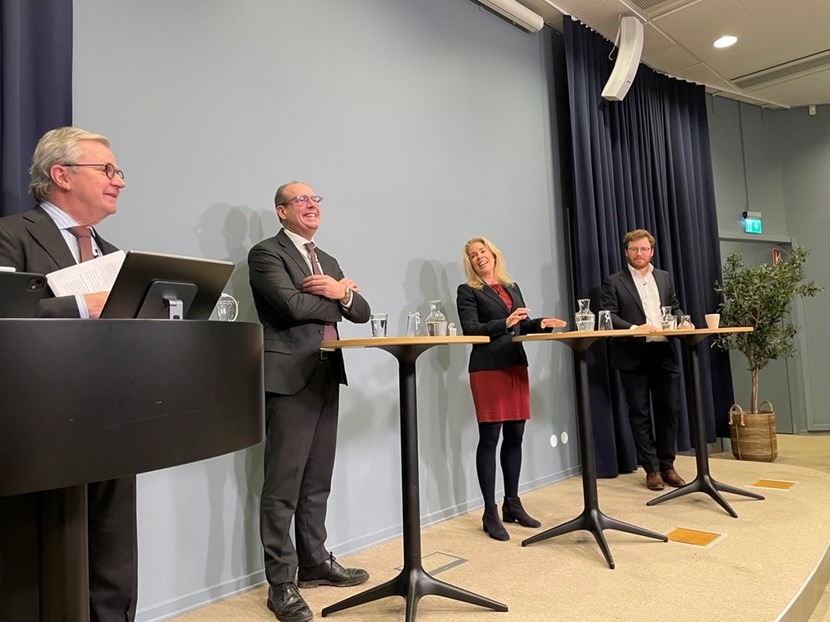
The seminar, hosted by Studieförbundet Näringsliv och Samhälle (SNS), Sveriges Riksbank and Swedish House of Finance (SHoF), brought together Aino Bunge, Deputy Governor of the Riksbank, Adrien d’Avernas, Associate Professor (SHoF/SSE), and Kristian Gårder, Co-Head of Equities at SEB. The speakers explored the potential impact of stablecoins on traditional currencies, the role of central banks in safeguarding stability, and the private sector’s central role in developing the necessary infrastructure.
Bunge emphasized that stable coins are growing rapidly worldwide and have the potential to improve, among other things, cross-border payments. However, they can also create financial stability risks, the risk of runs, dominant actors, dollarization, and undermine the singleness of money. Therefore, clear and cross-border regulation is needed, and central banks must consider how transactions to and from stablecoins should be settled.
“Central bank money must remain relevant in the future. This may mean making it available for settling new types of assets and payment flows in a tokenized world,” she said.
Bunge also highlighted the geopolitical perspective: payment systems are a potential vulnerability and can be used as a weapon, which requires resilience, redundancy, and reduced unilateral dependence on foreign infrastructure.
She described the Riksbank’s work to connect to European platforms such as TIPS and T2, the development of instant payments and standardization, as well as efforts to strengthen preparedness, including the possibility of making offline card payments for essential goods during prolonged outages.
The digital euro was presented as a major infrastructure project intended both to strengthen resilience and reduce dependence on foreign systems. At the same time, it raises the question of a Swedish e-krona. Bunge stressed that Sweden will likely need to take an active position on this issue in the coming years, since issuing an e-krona requires legal changes and long-term planning.
“The private sector will continue to play a central role. Innovation, cooperation, and investment in core infrastructure are essential, otherwise Sweden risks falling behind,” Bunge said.
In closing, she underlined the importance of the private sector for innovation and development, including making full use of the potential for instant payments. To ensure Sweden does not fall behind, continued innovation, collaboration, and several active decisions will be required in the years ahead.
Adrien D’Avernas unpacked the concept of stablecoins and their role within the broader crypto ecosystem. He explained why these instruments emerged in the first place while institutions and market participants need a way to stabilize the relative value of cryptocurrencies, much like central banks work to stabilize national currencies.
According to d’Avernas, the stablecoin landscape revolves around three key players: users, exchanges, and the platform that governs and manages the coin, each with its own incentives and vulnerabilities.
D’Avernas then turned to the case of Terra Luna, an algorithmic stablecoin launched in 2018. He described how the system attempted to maintain its peg using two interconnected tokens: Terra, the stablecoin itself, and Luna, the equity-like token designed to absorb volatility. Stability was maintained through continuous minting and burning of these tokens, a mechanism meant to align supply and demand. Luna holders benefitted from seigniorage revenue, as the platform effectively created valuable assets to keep Terra at its target price.
But the model also had fragilities. D’Avernas walked through the dramatic collapse of the Terra Luna ecosystem in May 2022, when a sudden loss of confidence triggered a downward spiral. Retail investors, especially in South Korea, suffered heavy losses. The episode exposed significant consumer-protection challenges and highlighted that seigniorage revenue depends on sustained demand. D’Avernas pointed out that, algorithmic stablecoins would need to redesign their business models and introduce explicit fees to cover these risks.
The discussion then shifted to fully collateralized stablecoins, such as Tether and USDC, which are backed by highly liquid assets rather than algorithms. D’Avernas explained how these issuers earn seigniorage through the interest on their collateral, while paying zero interest to the holders of the stablecoin. This structure, while more stable, raises its own concerns about the quality and liquidity of the underlying assets.
For these coins, d’Avernas stressed, transparency is everything: regular audits and clear reporting on reserves are essential for maintaining trust and ensuring long-term stability in this rapidly evolving market.
“Stablecoin can be a strong competitor both for traditional currencies, but also for traditional bank deposits”, said d’Avernas and continued:
“I see this as very healthy competitive forces because it creates a very strong push both for the central banks and the traditional banks to innovate and to stay in the game.”
Kristan Gårder offered a practical take on digital payments and digital assets, drawing on his experience supporting a digital bond issued by the European Investment Bank. He highlighted both the potential of new technology and the risks that remain around unregulated crypto instruments.
He introduced Qivalis, a consortium of nine European banks developing a regulated stablecoin, stressing that transparency, compliance, and trust are key for stablecoins to scale, and that banks are well placed to provide this.
The conversation was moderated by Pehr Wissén (SHoF).