
What should future capital requirements for banks look like?
In Sweden, Parliament recently decided that the Riksbank will assume responsibility for setting the countercyclical capital buffer. How should this and other capital buffer requirements be designed and applied going forward?

Since the financial crisis, capital requirements have increased both in Sweden and internationally. An international debate is now underway on the need to simplify and modernise banking regulation. In the United States, among others, there are proposals to ease parts of the regulatory framework. What considerations should guide this process, and how important are common international standards?
With calls to simplify and modernize banking regulation, what trade-offs arise in this process, and how important are common international standards for financial stability and a level playing field?
Against this backdrop, Riksbank Governor Erik Thedéen, who also serves as Chair of the Basel Committee on Banking Supervision, will share his perspective on these developments and on the future direction of bank regulation.
Governor remarks will be followed by a panel discussion.
Speakers
Erik Thedéen, Governor of Sveriges Riksbank
Kasper Roszbach, Professor of Economics, Lund University
Linda Fagerlund, CEO, Danske Bank Sweden
The panel will discuss how capital regulation may evolve in the coming years, drawing on both academic and practitioner perspectives.
The seminar is jointly organized by the Riksbank, the Swedish House of Finance, and SNS.
The discussion will be held in Swedish and moderated by Pehr Wissén, PhD, Professor Emeritus of Practice, Swedish House of Finance.
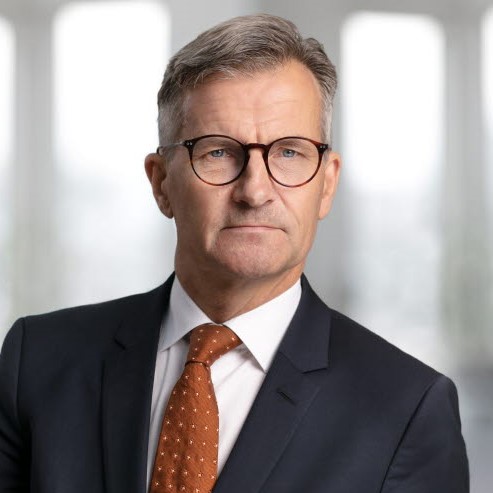
Erik Thedéen
Governor of Sveriges Riksbank

Kasper Roszbach
Professor of Economics at Lund University

Linda Fagerlund
CEO at Danske Bank Sweden