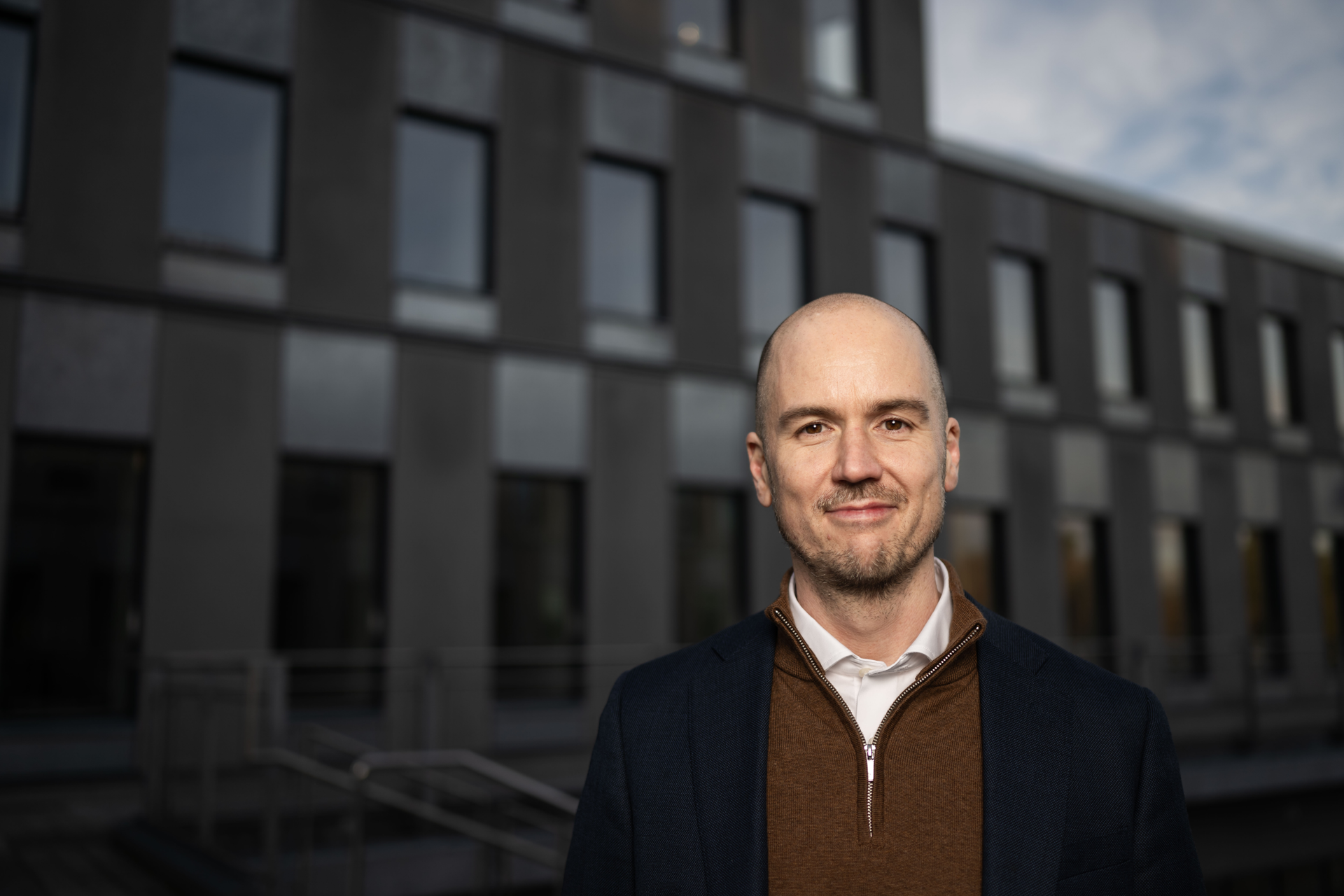
Following finance from crisis to climate: Spotlight on Gustav Martinsson
Gustav Martinsson has spent his career studying how finance shapes the wider economy – from innovation and productivity to the climate transition. As co-director of the Financial Markets Platform at the House of Sustainable Society, he now focuses on how high-emitting industries can decarbonize while societies and economies continue to function.

Gustav Martinsson, Professor of Financial Economics at Stockholm University and affiliated with both the House of Sustainable Society and Swedish House of Finance at the Stockholm School of Economics, has long been interested in what financial markets mean beyond the numbers.
Growing up in the university town of Lund, Gustav moved to Linköping to study economics and statistics. While writing his Master thesis, he discovered that he particularly enjoyed researching questions about how society works and how it can change.
Finding the bigger questions
After graduating, Gustav joined an asset management firm in Stockholm. The experience confirmed his interest in finance, although perhaps not in the way he expected.
“I probably didn’t get the most exciting job in the finance industry,” he says. “But I remember thinking: why on earth did I study for five years to do this?”
The financial system itself, however, fascinated him. The global financial crisis piqued Gustav’s curiosity about how shocks in financial markets could spread through economies far beyond their origin.
“How could problems in the US banking sector lead to a recession in Sweden? It wasn’t obvious to me at the time,” he says. “I wanted to understand the system and the patterns behind what we were seeing.”
A former supervisor alerted him to a PhD position at KTH Royal Institute of Technology. Gustav initially imagined the degree as a route toward jobs in government institutions, such as the Ministry of Finance. Instead, he became hooked on research.
“There’s something addictive about working independently on ideas and to find solutions around a problem,” he says. “So I kept going.”
Research as a way to influence society
The appeal of academia goes beyond the freedom to choose which questions to investigate.
“For me, it comes down to an interest in society and wanting to understand how it works. I’m attracted to the idea of independent observers and analysts of society, people trying to understand things without trying to sell you something or having vested interests,” he says.
“Ultimately, it’s about wanting to have an impact. That’s the drive. It’s a very privileged position to have the opportunity to potentially influence society from an academic perspective.”
Gustav’s early research examined how disruptions in financial markets affect the real economy over the long term. One important link is innovation. Developing new technology often requires investment today while generating revenues only years later. This makes access to finance particularly important for young and innovative companies.
His research connected the way banks and financial markets function with companies’ ability to invest, innovate, and become more productive. It also highlighted a less visible cost of financial crises: promising innovation projects may be delayed or abandoned when funding disappears, with consequences that can persist long after the immediate crisis has passed.

When finance meets climate change
Over time, those same questions led him toward climate finance. Macroeconomic models that had informed his work on innovation and long-term growth increasingly incorporated climate change. The connection was natural: it matters not only how much innovation an economy finances, but also what kind.
For someone interested in the forces shaping society, there was one issue that became impossible to ignore.
“Climate change is the challenge of all challenges,” he says.
Rather than representing a completely new direction, sustainable finance allowed Gustav to build on his previous work. Questions about funding, innovation, productivity, and long-term economic development remained at the center, but were now applied to the transition from fossil-based technologies toward more sustainable alternatives.
An early researcher in the field of sustainable finance, Gustav has been involved with the House of Sustainable Society since its inception. Through connections from his postdoc at the Swedish House of Finance, he was part of a call in 2016 to establish a larger research environment around sustainable finance at the Stockholm School of Economics. What started as Mistra Financial Systems later merged with the Mistra Center for Sustainable Markets (Misum) and, eventually, became the House of Sustainable Society.
Having been involved with the House since before it was established as a Research House at the Stockholm School of Economics, Gustav became co-director of the Financial Markets Platform in 2026.
Understanding trade-offs in decarbonization
Today, his research focuses on a particularly challenging part of the transition: how high-emitting sectors can decarbonize while continuing to provide the goods, services, and economic activity society relies on.
“When it’s easy to reduce emissions and it doesn’t really cost anything, then it’s a win-win,” he says. “The interesting questions arise when there are real trade-offs. We need to understand how expensive, or perhaps not so expensive, decarbonization is.”
The research includes collaboration with researchers at the Swedish central bank, as well as dialogue with policymakers. Gustav wants the findings to help decision-makers understand not only whether climate policies reduce emissions, but also how they affect investment, productivity, competitiveness, and companies.
“We don’t question that there needs to be a transition. We need to decarbonize. That, we take as a given,” he says. “But how we do it is going to be important in so many different ways. These massive transitions need to work across decades, so we need to find ways that can persist.”
In many ways, his current research returns to the questions that first drew him to academia: understanding how complex systems work, following their consequences beyond the most obvious effects, and producing knowledge that can help society make better-informed choices.
Photo: Johanna Säll