Handelshögskolan i Stockholm 

Handelshögskolans historia

Slutet av 1800-talet och början av 1900-talet karaktäriserades av en snabb industriell utveckling, vilken i sin tur ledde till att behovet av utbildade affärsmän och företagsledare ökade.


Svenskt näringsliv insåg snart vikten av högre utbildning inom detta område, och 1906 bildades därför Handelshögskoleföreningen för att få till stånd en handelshögskola i Stockholm.


Tre år senare (1909) kunde Handelshögskolan i Stockholm slå upp sina portar för de första 110 studenterna - detta tack vare stor hjälp från ett antal inflytelserika affärsmän i Stockholm, bl.a. K.A. Wallenberg, Olof A. Söderberg och Joseph Nachmanson och tack vare privata donationer, finansiellt stöd från Stockholms stad och statsanslag. Utbildningen som erbjöds var tvåårig och högskolan låg då vid Brunkebergstorg, där lokaler hyrdes i en fastighet känd som Brunkebergs hotell.


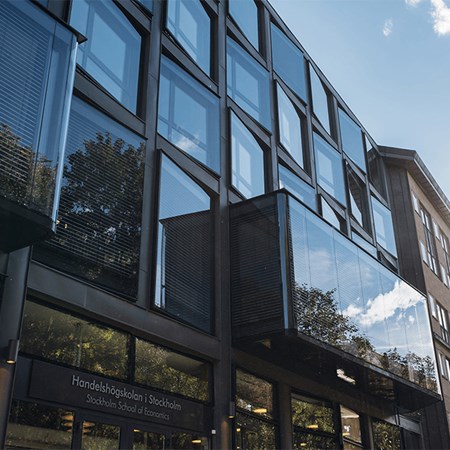
Med tiden ökade antalet studenter och utrymmet vid Brunkebergstorg räckte inte till. 1926 flyttade därför HHS till en nybyggd fastighet på Sveavägen 65, som även idag är vår huvudbyggnad. Den nya högskolan påminner om en nyklassicistisk monumentalbyggnad och arkitekt var Ivar Tengbom. Idag har högskolan också andra byggnader i kvarteren runt Sveavägen 65.

A century with the Stockholm School of Economics
1900 The idea of starting a university-level school for further education in business studies is born. The Söderberg and Wallenberg families, among others, are behind the initiative.
1903 Bank Director K A Wallenberg donates SEK 100,000 as an initial contribution to a business school in Stockholm.
1905 On K A Wallenberg's initiative, Sweden's National Board of Trade asks the King to commission Rector Å W:son Munthe of the Frans Schartau practical business institute, and grammar school governor A Nordfelt, to travel Europe and the United States ‘to study the newest and best-reputed institutes of higher education in business studies’.
1906 The Stockholm School of Economics Association is formed and constituted in the Main Hall of the Stockholm Stock Exchange. The founding member was the person who agreed to make an annual donation of SEK 400 for the next five years.
1907 The SSE Association has 250 members. With members' contributions, the initial contribution of SEK 100,000 and a donation of SEK 200,000 from Stockholms Enskilda Bank, the Association has a total of SEK 800,000.
1909 The Stockholm School of Economics is officially opened, and 110 students begin studying at the first university of its kind in Sweden. The library opens. Eli F Heckscher and Gunnar Andersson are appointed SSE's first professors in national economics and economic geography respectively.
1911 The first students graduate from SSE.
1926 Teaching begins in the premises at Sveavägen 65.
1929 THE SSE’s first research institute is formed, the Economic Research Institute.
1968 The Swedish Institute of Management is founded.
1971 SSE is a co-founder of the European Institute for Advanced Studies in Management and the European Foundation for Management Development.
1975 The Institute of International Business is formed.
1986 SSE Executive Education begins.
1991 SSE becomes a member of the Community of European Management Schools, CEMS.
1994 SSE Riga opens
1995 The International Graduate Program at the Stockholm School of Economics is introduced.
1997 SSE Russia opens.
1999 SSE is accredited by the European Quality Improvement system, EQUIS.
2004 Professor Lars Bergman becomes the SSE’s 10th President.
2007 The study structure is modified following alignment with the Bologna Process.
2008 A new undergraduate program focusing on retail begins in Norrtälje.
2009 SSE’s 100th anniversary and New Master of Science programs. SSE 100 years »